How to fix Google Ads disapproved compromised site error in wordpress
Table of Contents
- What does the Google Ads “Compromised Site” issue mean?
- What Is the Impact of the Google Ads “Compromised Site” Issue on Your Business?
- Typical Google Ads Disapproval Messages for a Compromised Site
- What Causes the Google Ads ‘Compromised Site’ Error in WordPress?
- How to Check the Status of Your Site for a Compromised Site Issue
- How to fix the Google Ads compromised site error in wordpress
- How to Prevent Future Google Ads ‘Compromised Site’ Issues
- Conclusion
What does the Google Ads “Compromised Site” issue mean?
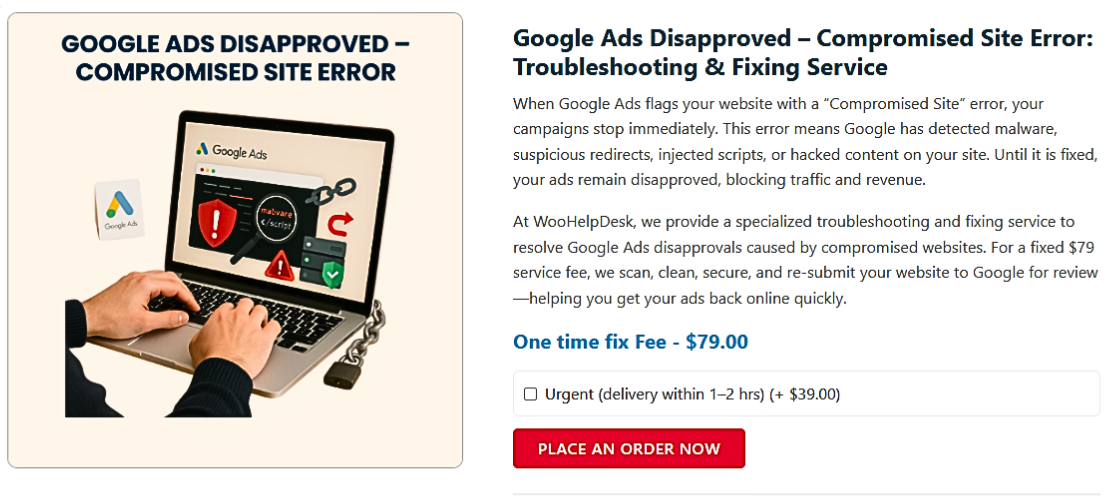
Google Ads runs a deep security crawler on every landing page you promote. The crawler renders the DOM, watches each HTTP request, and hashes every file. It compares those hashes to Google’s live malware and phishing database. If the scan spots injected scripts, hidden redirects, or skimmer code, it pauses ads. Your dashboard then shows the Google Ads compromised site error in wordpress status.
A compromise is not a single virus; it is unauthorized code execution. Attackers often exploit outdated plugins or weak credentials in WordPress. They drop backdoor PHP files that insert obfuscated JavaScript at run time. JavaScript may steal payment data, force downloads, or hijack traffic. Such behaviour triggers a Google Ads security issue, wordpress policy violation.
The label differs from “Malicious Software” because intent is irrelevant here. Even a legitimate brand is blocked if hackers alter one file. Until every artifact is gone, Google keeps the domain black-listed. Remove rogue code, restore clean backups, and update all components.
Submit scan reports and request re-crawling to fix Google Ads compromised site. If malware was present, a clean review also clears the Google Ads malware error wordpress alert.
What Is the Impact of the Google Ads “Compromised Site” Issue on Your Business?
A “Compromised Site” flag freezes every campaign that points to your domain. Google’s crawler has found code it believes could harm users, so ads are paused until you prove the threat is gone. That single alert ripples through sales, reputation, and operations. Below are the five biggest business impacts, each explained in plain but technical terms.
- Immediate Ad Shutdown and Revenue Loss — When Google detects a Google Ads compromised site error in wordpress, it disapproves every ad that points to the flagged domain. Campaigns halt within minutes, killing clicks, leads, and sales. E-commerce sites that rely on constant paid traffic can lose thousands in a single day, while fixed operating costs keep running.
- User-Trust and Brand-Reputation Damage — Browser warnings often appear alongside the Google Ads security issue wordpress notice. Shoppers see red alerts or Safe-Browsing blocks, assume the site is dangerous, and bounce instantly. Negative comments on social media amplify fear and erode credibility. Rebuilding trust demands public statements, visible security seals, and time, costing far more than the original ad spend.
- Remediation Costs and Technical Debt — Clearing the violation requires deep scans, developer hours, and sometimes outside incident-response teams to fix Google Ads compromised site. You may need to replace infrastructure, upgrade hosting, license premium security plugins, and conduct multiple verification scans. These unplanned expenses strain cash flow, especially for small Canadian firms operating on thin margins.
- SEO Knock-On Effects — A hacked domain can trigger organic-search penalties. Google may de-index infected URLs or demote rankings until the Google Ads malware error wordpress threat fully disappears. Free organic traffic falls alongside paid clicks, forcing heavier dependence on alternative channels and increasing overall customer-acquisition costs.
- Risk of Full Account Suspension — Repeated compromised-site violations escalate from ad disapprovals to complete Google Ads account suspension. A suspended account cannot launch new campaigns or leverage historical Quality Scores. Rebuilding under a fresh account starts with low spend limits and higher CPCs, letting competitors capture market share while you restart from zero.
Typical Google Ads Disapproval Messages for a Compromised Site
Google Ads groups security violations under six policy labels. Each label tells you why ads stopped and what to repair. When anyone appears, often alongside Google Ads compromised site error in wordpress, all campaigns pause until you prove the threat is gone. Below, every label is explained in plain yet technical terms so your dev team can respond fast.
- Malicious software
This warning appears when Google detects code that silently installs programs. The dashboard shows Google Ads malware error wordpress beside every paused ad. The crawler matched your scripts or binaries to a malware signature. Remove the infected files, restore verified backups, run a complete antivirus scan, and submit the clean reports in your appeal so Google can lift the block. - Compromised sites
The most common flag is Google Ads compromised site error in wordpress. It means attackers changed PHP, JavaScript, or database rows to steal data or push hidden redirects. Diff your WordPress core against official checksums, delete rogue plugins, patch all vulnerabilities, and lock file permissions. Provide before-and-after logs to prove the domain is safe when requesting a manual re-crawl. - Unwanted software
Google shows this label when visitors are offered toolbars, cryptominers, or installers they never asked for. The policy engine adds a Google Ads security issue wordpress note to the affected URLs. Audit outbound links, third-party scripts, and CDN calls. Remove any bundle that violates policy, then supply fresh link scans in your appeal to restore ad delivery. - Unfair advantage
This disapproval targets cloaking or location-based content swapping that misleads Googlebot. Such logic can survive after teams fix Google Ads compromised site but forget old redirect rules. Ensure crawlers and users receive the same HTML, strip hidden text, and document the update. A clear explanation speeds reinstatement and protects future Quality Scores. - Evasive ad content
Evasive content flags fire when JavaScript rewrites links or images after Google’s first check. Attackers embed this to hide spam or scams. Locate and delete dynamic scripts that alter page elements, enforce read-only permissions on theme files, and add strict Content-Security-Policy headers before submitting your appeal. - Circumventing systems
Repeated attempts to relaunch ads without fixing root problems escalate to “Circumventing systems.” Google views this as deliberate evasion and may suspend the entire account. Provide a timeline of fixes, third-party security certificates, and a proactive monitoring plan. Submitting everything together shows full compliance and increases the chance of regaining advertising access quickly.
What Causes the Google Ads ‘Compromised Site’ Error in WordPress?
- Unpatched core, themes, or plugins — Public exploits for old WordPress versions, WooCommerce add-ons, and page-builder plugins let attackers upload PHP shells or overwrite files. Once the shell injects obfuscated JavaScript, Google’s crawler detects malicious behaviour and shows the Google Ads compromised site error in wordpress status. Rigid update schedules, automatic patching, and checksum monitoring cut this leading risk.
- Nulled or pirated extensions — “Free” premium themes often ship with hidden loaders that install spyware, crypto-miners, or spam links. These unwanted binaries trigger a Google Ads malware error, wordpress disapproval because they attempt silent downloads on visitor machines. Always buy from trusted marketplaces and scan uploads with Wordfence CLI before activation to avoid this self-inflicted compromise.
- Injected redirect hacks — Attackers rewrite .htaccess, functions.php, or the wp_options table to force 301/302 chains to gambling or fake-pharma domains. Google spots the covert jump and flags a Google Ads security issue wordpress violation for “suspicious redirect.” Cleaning demands diffing server configs, purging rogue database rows, and resetting file permissions so hackers cannot reinstate the rule.
- Back-door PHP and database payloads — SQL-injection or weak-credential attacks drop files like wp-includes/wp-tmp.php. These loaders pull remote scripts, embed credit-card skimmers, and cloak content to evade casual checks. Google recognizes the pattern as “Compromised site” and pauses ads until you remove every shadow file and sanitize the database.
- External resources from black-listed domains — Legitimate pages can still fail scans if they load CSS, JS, or iframe content hosted on servers already flagged for malware. Even a single unsafe CDN call produces an unwanted software label. Replacing or self-hosting third-party assets, plus enabling Sub-Resource Integrity, fixes the error quickly.
- Mixed-content and HTTP script calls — HTTPS pages that reference non-TLS images or libraries inherit the remote host’s reputation. Google treats those insecure calls as potential drive-by download vectors and records a policy strike. Force HTTPS everywhere with HSTS, update hard-coded URLs, and rerun scans to clear the notice.
- Incomplete cleanup or cached malware — Website owners sometimes delete visible threats but leave backups, old cache files, or server-side includes that still point to infected resources. Google re-crawls, finds the residue, and repeats the disapproval. Only a full file-system audit, CDN purge, and fresh malware report will finally fix Google Ads compromised site warnings for good.
How to Check the Status of Your Site for a Compromised Site Issue
- Google Ads → Policy Manager
Open Tools ▸ Policy Manager and filter by “Disapproved.” A line reading Google ads compromised site error in wordpress, proves Google’s crawler found malicious code. Download the sample URLs and note the crawl timestamp. These clues show which page, script, or redirect triggered the violation, giving developers a precise starting point for investigation and cleanup. - Google Search Console Security Issues
In Search Console, navigate to Security & Manual Actions ▸ Security Issues. If the banner displays a Google Ads security issue, wordpress, or “Hacked site,” Google’s organic index sees the same threat. Export the URL list, compare it with Policy Manager data, and map overlaps; shared paths nearly always highlight the plugin, theme, or upload folder attackers breached. - Google’s External Safe Browsing Site Status Checker
Visit the Transparency Report tool and paste your domain. If the checker still marks the site “Dangerous,” a manual review will fail. Rerun the test after each fix; when it shows “No unsafe content,” reference that clean result in your appeal to fix Google Ads-compromised site faster and boost reviewer confidence in your remediation steps. - Third-Party URL Scanners (Sucuri, VirusTotal)
Scan key landing pages with Sucuri SiteCheck or VirusTotal. These services flag injected JavaScript, black-listed CDN calls, or hidden iframes. Matching detections often mirror the Google Ads malware error wordpress notice inside Policy Manager. Save a clean PDF after remediation; independent evidence from multiple scanners strengthens your appeal packet. - Wordfence or WP-CLI Integrity Audit
Run Wordfence’s full scan or use wp core verify-checksums and wp plugin list –status=modified. The tools hash every core, theme, and plugin file, revealing altered code and back-door PHP shells. Cross-reference suspicious timestamps with Google’s sample-URL times; aligned events confirm the breach window and verify that all infected files are now gone.


How to fix the Google Ads compromised site error in wordpress
- Confirm the exact policy violation
Open Google Ads → Tools → Policy Manager. Look for “Compromised site,” “Malicious software,” or similar flags. Copy the sample URLs and crawl timestamps. Check Google Search Console → Security Issues to see whether the same pages appear. Matching data proves Google’s crawler, not your browser, found the infection and frames the work ahead in clear, measurable goals. - Switch to maintenance mode and back up everything
Install a maintenance-mode plugin or add a 503 rule in .htaccess so visitors stay safe while you clean. Use your host’s backup tool or a plugin like UpdraftPlus to export the database and the entire wp-content tree. Store the archive off-server. A clean snapshot lets you roll back if a mistaken deletion breaks layouts or plugins. - Run layered security scans across files and the database
Install Wordfence or MalCare and run a high-sensitivity scan. These tools compare core, theme, and plugin files to official hashes and flag obfuscated scripts. Follow up with Sucuri SiteCheck or VirusTotal URL scans for outside confirmation. Search the database for base64, eval(, and strange iframes. Compile every infected path into a checklist for removal. - Replace or delete everything that’s infected
Remove nulled or outdated plugins, delete hacked themes, and overwrite wp-admin and wp-includes with fresh copies from WordPress.org. Purge malicious code from functions.php, headers, and footers. In phpMyAdmin, delete rogue options and unknown admin accounts. Work slowly; one missed backdoor can reinfect the server and revive the error after you think it’s fixed. - Harden WordPress and the hosting stack
Change all passwords—admin, FTP, SSH, cPanel, database. Update every plugin and theme, then enable automatic updates where safe. Set file permissions to 640 for PHP and 750 for directories. Turn on two-factor authentication, limit login attempts, and add a Web Application Firewall. HSTS and a strict Content-Security-Policy header block future script injections. - Verify cleanliness and gather proof for Google
Clear server, CDN, and browser caches. Re-run Wordfence and external scanners until every report shows “clean.” Save PDF scan results, diff logs, and a short change list. Check Google’s External Safe-Browsing Site-Status Checker; it should report “No unsafe content.” These documents form the evidence bundle you’ll attach in the appeal. - Submit a detailed appeal and monitor continuously
Back in Policy Manager, click Request Review beside each disapproved item. Explain that malware was removed, files restored, and security hardened; attach your evidence. Do the same in Search Console if a warning exists. Google usually replies within 48 hours. After approval, keep daily scans and weekly audits running so the compromise and disapproval never return.
How to Prevent Future Google Ads ‘Compromised Site’ Issues
- Keep WordPress, plugins, and themes always updated
New releases patch exploits that hackers use to plant malware, which then triggers the Google Ads compromised site error in wordpress. Turn on automatic updates, review changelogs weekly, and delete abandoned extensions. Staying current closes most known holes and satisfies Google’s “safe-software” expectation. - Use only trusted, licensed extensions
Nulled or pirated themes often carry back-door code that Google flags as malicious software. Buy directly from reputable vendors, verify checksums after download, and scan new ZIPs with Wordfence before activation. Avoiding shady sources stops hidden scripts that could lead to a future Google Ads security issue or wordpress violation. - Enforce strong authentication and least-privilege access
Enable two-factor authentication for all admins, use unique 20-character passwords, and assign editor roles only when required. Tight credentials block brute-force logins that inject malicious iframes, preventing repeat Google Ads malware error wordpress disapprovals. Wordfence’s built-in 2FA and login-attempt limiter make this step easy to roll out. - Harden the server and file system
Set directories to 750 and files to 640; restrict wp-config.php to 400. Add a Web Application Firewall (e.g., Sucuri WAF) to block SQL injection and XSS payloads before they touch WordPress. Proper permissions and a WAF align with OWASP guidance and stop drive-by exploits that Google’s crawler later condemns. - Activate continuous monitoring and automated backups
Schedule daily malware scans with Wordfence or MalCare and weekly external scans via Sucuri SiteCheck. Keep at least three rolling off-site backups, stored in separate locations, so you can restore quickly if infections reappear. Routine monitoring catches threats long before Google disapproves of ads, while backups provide an instant recovery path. - Add security headers and Content-Security-Policy
Deploy HTTPS with HSTS and define a strict Content-Security-Policy to block inline scripts and unauthorized domains. CSP helps prevent injected JavaScript from executing, thereby averting the behaviours Google labels as “Compromised Site.” Modern browsers and Google’s own Safe-Browsing systems respect these headers, boosting both ad compliance and visitor safety. - Check Safe Browsing and Policy Manager routinely
Run Google’s External Safe Browsing Site-Status Checker after each update cycle and review the Ads Policy Manager weekly. Swiftly addressing any warning keeps campaigns live and users protected. Early detection through these Google tools means you can remediate issues before they escalate into another fix Google Ads compromised site campaign shutdown.
Conclusion
A “Compromised Site” warning in Google Ads means Google’s security crawler has found unauthorized code—malware, hidden redirects, or unsafe scripts—on your WordPress pages. When that happens, ads pause instantly, traffic and revenue drop, and your brand’s reputation can suffer.
Resolving the problem follows a straightforward path: identify the exact policy message, scan the entire site, remove every infected file, secure WordPress with updates and strong logins, and then request a manual review. After Google confirms the site is clean, ads resume.
Keeping your site safe in the long run requires consistent maintenance: apply updates promptly, use reputable themes and plugins, enable two-factor authentication, run daily malware scans, and monitor Google Safe Browsing and Policy Manager for early warnings. With regular attention, you can avoid future disruptions, protect visitors, and keep your campaigns running smoothly.
Need expert help right away? Call us today at+1 888 602 0119 (US & Canada) for immediate support on WooCommerce and WordPress sites.