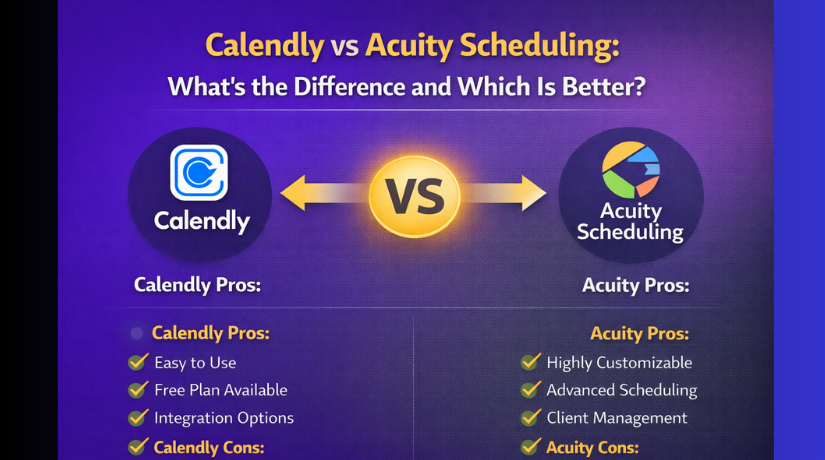
Calendly vs Acuity Scheduling: What’s the Difference and Which Is Better?
Table of Contents
- Introduction
- What is Calendly Scheduling?
- What are the Key Features, Pros and Cons of Calendly Scheduling?
- What is Acuity Scheduling?
- What are the Key Features, Pros and Cons of Acuity Scheduling?
- What’s the Difference Between Calendly and Acuity Scheduling?
- Final Verdict
Introduction
Time is your most valuable asset. Every hour spent coordinating meetings is an hour not spent growing your business. Scheduling tools promise to eliminate the back-and-forth email tennis, letting clients book directly on your calendar.
Two of the most established names in this space are Calendly and Acuity Scheduling. Both have millions of users and strong reputations. But they serve fundamentally different types of businesses.
Calendly built its reputation on simplicity . It’s the tool you can set up in five minutes and forget about. For solo entrepreneurs and sales teams who just need meetings on the calendar, Calendly is the obvious choice.
Acuity Scheduling (now owned by Squarespace) took a different path. It’s packed with features for service businesses that need more than just scheduling: payment processing, intake forms, client management, and packages. It’s for businesses where appointments directly generate revenue.
This guide provides a comprehensive, unbiased comparison of Calendly and Acuity Scheduling in 2026. You’ll learn about their key features, strengths, limitations, and ideal use cases. You’ll see detailed comparisons of pricing, integrations, and customization options.
By the end, you’ll know exactly which scheduling tool fits your specific needs.
What is Calendly Scheduling?
Calendly is the scheduling automation platform that most people think of first. It’s been around the longest and has built a strong brand around simplicity and ease of use.
Calendly’s approach is straightforward: connect your calendar, set your availability, create event types, and share your link. That’s it. The interface is clean and intuitive for both you and your clients.
The platform is designed to handle complex scheduling scenarios for various team types and industries, from solopreneurs to large enterprise companies. Calendly powers scheduling for four out of five Fortune 500 companies.
How Does It Work?
- When you sign up, Calendly walks you through connecting your calendar (Google, Outlook, iCloud), setting your availability, and creating your first event type.
- Within minutes, you have a shareable booking link (like calendly.com/yourname) that people can use to book time with you.
- It checks your calendar for conflicts, handles time zones automatically, and sends confirmation emails.
What are the Key Features, Pros and Cons of Calendly Scheduling?
Key Features of Calendly
- Seamless Calendar Integration: Connect with Google Calendar, Outlook, Office 365, and iCloud. Calendly checks all your calendars for conflicts, ensuring you’re never double-booked.
- Automated Scheduling: Set your availability once, and Calendly handles the rest. Confirmation emails, reminders, and follow-ups happen automatically.
- Multiple Event Types: Create different meeting types (15-minute intro calls, 60-minute strategy sessions) with their own durations, availability rules, and settings.
- Team Scheduling Features: Advanced options include:
- Round-robin – Automatically distributes meetings across team members
- Collective scheduling – Finds times when multiple people are available
- Routing forms – Screens and qualifies leads, then routes them to the right person
- Over 100 Integrations: Connect with CRM tools (Salesforce, HubSpot), video conferencing (Zoom, Microsoft Teams, Webex, Google Meet), and productivity apps.
- Payment Processing: Integrates with Stripe, PayPal, and Stax Payments to collect payments at booking, reducing no-shows.
- Customizable Branding: Add your logo, choose colors, and customize confirmation pages. Basic customization is included; advanced options available in paid plans.
- Workflows (Paid Plans): Create automated multi-step sequences for follow-ups, reminders, and internal notifications.
- Meeting Polls: Send polls to find the best time for group meetings without endless email threads.
- Mobile Apps: Available for iOS and Android, plus browser extensions for Chrome, Firefox, Edge, and Safari.
Calendly Pros
- Dead Simple to Set Up: You can be up and running in 5-10 minutes. The clean, modern interface makes scheduling effortless for both you and your clients.
- Excellent Integrations: With over 100 integrations, Calendly connects with the tools you already use. The CRM integrations (Salesforce, HubSpot) are particularly strong for sales teams.
- Generous Free Plan: The free plan includes unlimited meetings, one calendar connection, and one active event type. That’s genuinely useful for freelancers and consultants just starting out.
- Team Features That Work: Round-robin and collective scheduling make coordinating team availability straightforward.
- Professional Booking Pages: Clean, branded pages that clients actually enjoy using.
- Enterprise-Ready Security: ISO 27001 and SOC 2 Type 2 certified, PCI and GDPR compliant. Calendly meets the security requirements of large organizations.
- Intuitive for Clients: The booking experience is simple and frictionless, which means fewer abandoned booking attempts.
Calendly Cons
- Limited Customization Options: Compared to competitors, you’re working within Calendly’s templates. Custom CSS isn’t available.
- Many Power Features Require Paid Plans: Workflows, multiple calendar connections, and advanced team features are locked behind higher tiers.
- Payment Processing Limited: While you can accept payments, the options are fewer than Acuity. Not ideal for complex service businesses.
- No Built-In Client Management: Calendly keeps things minimal. No client history, notes, or relationship management features.
- Can Feel Too Basic: For businesses with complex scheduling needs (intake forms, packages, memberships), Calendly may not be enough.
- No HIPAA Compliance: Even on Enterprise plans, Calendly is neither HIPAA compliant nor does it sign BAAs. Not suitable for healthcare providers.
- Team Plan Is Expensive: The Teams plan costs 60% more than Standard, which adds up for growing teams.
- Steep Learning Curve on Teams Plan: The advanced features can overwhelm new users.
What is Acuity Scheduling?
Acuity Scheduling (now owned by Squarespace) takes a fundamentally different approach from Calendly. It’s built for service businesses where scheduling is directly tied to revenue.
Acuity is what you get when a scheduling tool is designed by people who actually run service businesses. It’s packed with features for salons, therapy practices, personal training, consulting, and any operation where the appointment is just one piece of a larger client management puzzle.


The platform supports the full lifecycle of an appointment—from intake forms to payment to follow-up. It’s designed to impress clients and grow your business.
How Does It Work?
- Acuity requires more upfront setup than Calendly.
- Expect to spend at least 30 minutes configuring things properly.
- But that investment pays off in greater control over your booking experience.
- You can create custom intake forms, set up appointment packages, manage subscriptions, and sell gift certificates—all within the same platform.
What are the Key Features, Pros and Cons of Acuity Scheduling?
Key Features of Acuity
- Deeply Customizable Booking Pages: Change colors, messaging, and even add custom CSS for complete brand control. Your booking page can match your website exactly.
- Client Intake Forms: Collect detailed information before appointments. Use conditional logic to show different questions based on previous answers.
- Client Management Database: Track appointment history, keep detailed notes, and manage the entire client relationship within Acuity.
- Robust Payment Processing: Integrates with Stripe, Square, PayPal, and Authorize.net. Accept deposits, full payments, packages, memberships, subscriptions, and gift certificates.
- Class Scheduling: Offer group classes and appointments, with capacity management and waitlists.
- Add-ons and Packages: Sell service add-ons and create package deals directly in the system.
- HIPAA Compliance: Available on higher-tier plans for healthcare providers handling protected health information.
- Smart Availability Management: Set complex availability rules, buffer times, and resource allocation.
- SMS Reminders: Send text message reminders to reduce no-shows (on higher plans).
- Zapier Integration: Connect with thousands of other apps through Zapier.
- Squarespace Integration: As a Squarespace company, Acuity integrates seamlessly with Squarespace websites.
Acuity Pros
- Deep Customization: You can control almost every aspect of the booking experience. Custom CSS, complex intake forms, and conditional logic give you complete flexibility.
- Excellent Payment Features: Acuity handles payments better than most competitors. Packages, memberships, subscriptions, and gift certificates are all built-in.
- Strong Client Management: Unlike Calendly’s minimal approach, Acuity gives you client history, notes, and relationship management tools.
- Intake Forms That Work: Collect the information you need before appointments. Conditional logic ensures clients only see relevant questions.
- HIPAA Compliance Available: For healthcare providers, Acuity offers compliant plans that Calendly can’t match.
- Ideal for Service Businesses: If appointments are your revenue stream, Acuity’s features are designed for exactly that.
- 24/7 Customer Support: Help is available around the clock.
- Embeddable Anywhere: Works on Squarespace and any other website platform.
Acuity Cons
- No Free Plan: Acuity starts at $16/month with no free tier. That’s a significant barrier for solo practitioners just starting out.
- Steep Learning Curve: The extensive features mean setup takes longer. Expect to spend at least 30 minutes configuring things properly.
- Dated Interface: The user interface feels less modern than Calendly’s. Some users find it less intuitive.
- More Expensive for Simple Needs: If you just need basic scheduling, Acuity is overkill and costs more than Calendly’s paid plans.
- Limited Plan Functions on Lower Tiers: One user noted that lower-tier plans have “limited payment method choices” and “limited customer support”.
- Not Ideal for Large Teams: Acuity’s team features aren’t as robust as Calendly’s for large enterprises. It’s best for solopreneurs and small businesses that don’t plan to grow quickly.
- Fewer CRM Integrations: Acuity doesn’t have the deep CRM integrations (Salesforce, HubSpot) that Calendly offers. Not ideal for sales teams.
- Can Be Complex: For users who just need a simple scheduler, Acuity’s power features can feel overwhelming.
What’s the Difference Between Calendly and Acuity Scheduling?
This table provides a comprehensive comparison of Calendly and Acuity Scheduling based on 2026 data.
| Comparison Factor | Calendly | Acuity Scheduling | Winner |
| Starting Price | Free (basic); $10/month paid | $16/month (no free plan) | Calendly |
| Free Plan | Yes (one active event type, one calendar) | No | Calendly |
| User Ratings (Ease of Use) | 4.7/5 | 4.6/5 | Calendly |
| User Ratings (Value for Money) | 4.5/5 | 4.7/5 | Acuity |
| User Ratings (Customer Support) | 4.4/5 | 4.7/5 | Acuity |
| Best For | Solo entrepreneurs, sales teams, anyone valuing simplicity | Service businesses, consultants, healthcare, payment-focused | Depends on need |
| Key Strength | Dead simple to use, excellent integrations | Deep customization, payment features, client management | Depends on need |
| Target Audience | Individuals to enterprise, sales, marketing, recruiting | Service-based solopreneurs and small-medium businesses | Depends on need |
| Core Philosophy | Simplicity, ease of use, meeting coordination | Full appointment lifecycle management, revenue-focused | Depends on need |
| Setup Time | 5-10 minutes | 30+ minutes | Calendly |
| Interface | Clean, modern, intuitive | Dated, less intuitive | Calendly |
| Customization | Basic (logo, colors) | Deep (custom CSS, intake forms, conditional logic) | Acuity |
| Client Intake Forms | Basic questions | Advanced with conditional logic | Acuity |
| Client Management Database | No | Yes (history, notes, tracking) | Acuity |
| Payment Gateways | Stripe, PayPal, Stax | Stripe, Square, PayPal, Authorize.net | Acuity |
| Package/Membership Sales | No | Yes | Acuity |
| Gift Certificates | No | Yes | Acuity |
| Class Scheduling | Limited | Yes | Acuity |
| SMS Reminders | Yes (paid plans) | Yes (higher plans) | Tie |
| Number of Integrations | ~100 | ~40 | Calendly |
| CRM Integrations | Strong (Salesforce, HubSpot) | Limited | Calendly |
| Video Conferencing | Zoom, Teams, Webex, Google Meet | Zoom, Google Meet, GoToMeeting | Calendly |
| Team Scheduling | Advanced (round-robin, collective, routing) | Basic | Calendly |
| HIPAA Compliance | No | Yes (higher plans) | Acuity |
| Enterprise Security | ISO 27001, SOC 2, GDPR, PCI | Basic security features | Calendly |
| Mobile Apps | iOS, Android | Yes | Tie |
| Owned By | Calendly | Squarespace | Depends on preference |
| Ideal Customer Size | Small to Large | Small to Medium | Calendly |
| Resource Scheduling | No | Limited | Tie |
| Client Selects Staff | No | Yes | Acuity |
| Admin-Side Scheduling | Complicated | Yes | Acuity |
Final Verdict
Calendly and Acuity Scheduling serve fundamentally different audiences, and the right choice depends entirely on your business type and needs.
Choose Calendly if you value simplicity, team coordination, and a friction-free booking experience. It’s the perfect tool for sales teams, recruiters, consultants, and professionals who just need meetings on the calendar without complex setup. The free plan is genuinely useful for solo users, and the paid plans start at an affordable $10/month.
With over 100 integrations, including deep CRM connections with Salesforce and HubSpot, Calendly fits seamlessly into existing workflows. The enterprise-grade security (ISO 27001, SOC 2) makes it suitable for large organizations. If your scheduling needs are straightforward—set availability, share a link, get booked—Calendly is the obvious choice.
Choose Acuity Scheduling if you run a service-based business where appointments directly generate revenue and you need payment processing, intake forms, and client management built-in. Acuity is designed for businesses like salons, therapy practices, personal training, and consulting where the booking process is more complex.
The deep customization, conditional intake forms, and comprehensive payment features (packages, memberships, gift certificates) make it a complete business management tool. The $16/month starting price is higher and there’s no free plan, but for businesses that need these features, it’s worth the investment. HIPAA compliance on higher tiers makes it suitable for healthcare providers.
Have questions before starting with WooCommerce & WordPress? Get support here at WooHelpDesk.