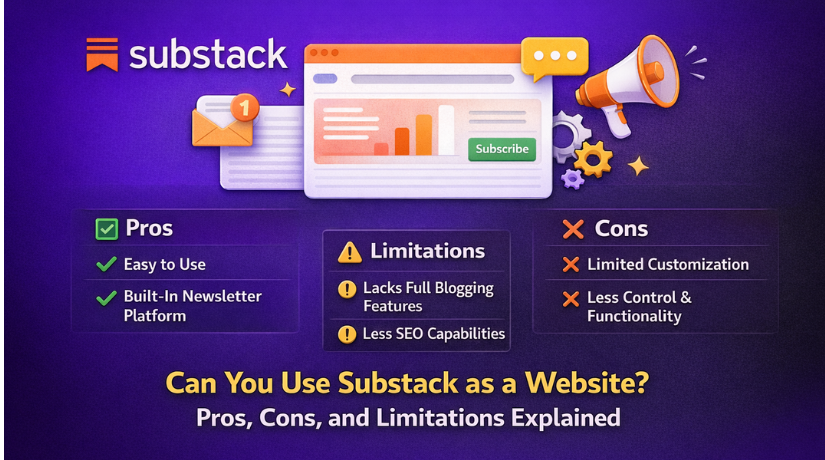
Can You Use Substack as a Website? Pros, Cons, and Limitations Explained
Table of Contents
- Introduction
- What is Substack?
- What are the Key Features of Substack?
- What are the Advantages of Using Substack?
- What are the Disadvantages of Using Substack?
- Can Substack be Used as a Website?
- Final Verdict
Introduction
In recent years, Substack has become synonymous with the newsletter renaissance. It promises an easy way for writers to publish, build an audience, and get paid. But is it a true website builder? The short answer is yes—with significant caveats.
Substack was never designed to be a full-fledged website builder. It is, at its core, a platform for email newsletters. However, every publication on Substack comes with a built-in web presence. This page is automatically generated and acts as an archive of your posts, an about page, and a subscription landing page rolled into one. The question is whether this basic online brochure can ever replace a proper website.
This guide will explore every facet of using Substack as your primary web home. You’ll learn exactly what Substack is, its key features, the advantages of using it, and—most importantly—its significant disadvantages and limitations. By the end, you will know whether a Substack publication is sufficient for your needs or whether you still need a proper website.
What is Substack?
Substack is a content publishing platform that was founded in 2017. It was built specifically for writers, journalists, and creators who want to publish newsletters, build an audience, and monetise their work through paid subscriptions.
At its heart, Substack is an all‑in‑one tool. It combines three critical functions into one simple dashboard: publishing, email delivery, and payment processing. You can write a post, send it to your subscribers’ inboxes, and charge for access—all without any technical knowledge.
The platform has become extremely popular among independent writers who want to escape the chaos of social media and build a direct, paid relationship with their readers. Substack has also attracted high‑profile journalists and thinkers who have left traditional media outlets to start their own paid newsletters.
However, Substack is not a general‑purpose website builder. It is a newsletter platform that happens to include a web archive. Every publication gets a default web page, but the focus remains squarely on the email inbox.
What are the Key Features of Substack?
Substack’s feature set is deliberately streamlined. It prioritises simplicity over versatility.
- Integrated Newsletter Publishing
Writing a post on Substack is as simple as using a basic word processor. You can add images, embed videos, and format text. When you publish, your post is simultaneously sent to your subscribers’ email inboxes and posted to your publication’s web page.
- Built-in Monetisation
Monetisation is Substack’s killer feature. You can turn paid subscriptions on or off with a single toggle. Substack handles all the payment processing, subscription management, and even the tax paperwork for US writers. The platform takes a 10% commission on subscription revenue. This is a high fee, but it covers the cost of everything else.
- Basic Web Presence
Every Substack publication comes with a simple website. It includes:
- A homepage displaying your latest posts
- An about page
- An archive page
- A subscription landing page
You can change the colours, add a logo, and choose from a few basic layouts (e.g., Feature, Magazine, Newspaper). You can also add a handful of custom pages (like a “Start Here” page). But the design control ends there.
- Email Deliverability and Infrastructure
One of the most valuable aspects of Substack is that it handles all the technical headaches of email marketing. You do not need to set up SMTP servers, manage bounce rates, or worry about your emails landing in spam. Substack has built a robust email delivery system that most individual writers could never replicate on their own.
- Subscriber Management and Analytics
Substack provides a simple dashboard where you can see your subscriber count, open rates, and click‑through rates. You can also see which posts are driving the most engagement. This data helps you understand what your audience wants to read.
- Network Effects and Discovery
Substack has a built‑in discovery feature. Readers can browse recommendations and find new newsletters based on topics they follow. If you are trying to grow from zero, this network effect is invaluable. As one review put it, “opening a Substack account makes you part of an instant community”.
What are the Advantages of Using Substack?
Before we dive into the limitations, it is important to acknowledge why so many writers are attracted to Substack in the first place.
- Ridiculously Easy to Start
You can create a Substack publication in about 60 seconds. You do not need to buy hosting, install software, or configure a domain name. The platform handles everything for you. This low barrier to entry is perfect for writers who want to focus on writing, not on technology.
- No Technical Knowledge Required
You do not need to know HTML, CSS, or any programming language. The writing interface is clean and distraction‑free. For many writers, this is liberating.
- All‑in‑One Solution for Newsletters
Substack combines writing, email delivery, payments, and community features into one tool. You do not need to piece together separate services for your newsletter, your payment gateway, and your email service provider.
- Direct Monetisation Out of the Box
If you want to start charging for your writing immediately, Substack makes it trivial. You can add a paid tier with one click. The platform even allows you to migrate your existing email list and set different price points.
- No Ongoing Costs for the Free Tier
Substack is completely free to use as long as you do not charge for subscriptions. You can publish as much as you want, build an audience, and never pay a cent. This makes it risk‑free for new writers.
- Built-in Audience and Discovery
Substack’s recommendation engine and network effects can help new writers find readers. When you start from zero, this built‑in audience is a significant advantage over launching your own standalone website.
- Automatic SEO and Sitemaps
Substack automatically generates a sitemap for your publication. This helps search engines index your content more efficiently. However, as we will see, the SEO benefits stop there.
- Substack Pro for High‑Profile Writers
For established writers, Substack offers an invite‑only “Pro” plan. The company reaches out to high‑profile authors and offers them advances to start publishing on the platform. This is a powerful incentive for well‑known voices to move their audience to Substack.
What are the Disadvantages of Using Substack?
Now we get to the core of the question. If you are considering using Substack as your primary website, you need to understand its severe limitations.


- Extremely Limited Customisation
Substack offers very little control over how your website looks. You can change the accent colour, add a logo, and choose between a few pre‑set layout options (Feature, Magazine, Newspaper). That is essentially it.
You cannot:
- Create a custom homepage design
- Add a sidebar with widgets
- Rearrange elements on the page
- Use a third‑party theme
- Add custom CSS or JavaScript
Every Substack website looks broadly similar. This is fine for a newsletter, but it is a serious limitation if you want a unique brand presence. As one critic noted, “Substack doesn’t allow you to design a proper profile website”.
- Weak SEO Performance
Substack’s SEO is notoriously poor. Multiple experts and long‑time SEO professionals have called it “abysmal” and “not SEO‑friendly”. The problem is fundamental: Substack’s platform architecture does not prioritise search engine visibility.
Key SEO issues include:
- You cannot set custom URL slugs. The SEO title field does not control the URL, which makes it hard to optimise for keywords.
- No canonical URLs. This means your content may be syndicated across other platforms without proper attribution, and search engines may not give you credit.
- Limited metadata control. You have basic control over meta titles and descriptions, but you cannot fine‑tune the technical SEO settings that are standard on platforms like WordPress.
- Content can become invisible. One reviewer bluntly stated, “your content becomes invisible to search engines. Substack’s SEO is so bad it’s almost like they designed it to hide your work from Google”.
For any business or creator who relies on organic search traffic, this is a deal‑breaker.
- You Do Not Own Your Content or Audience
This is the single biggest risk of using Substack as your only web presence. You are a tenant on someone else’s platform. As the Harvard article warns, “Don’t Build Your House on Rented Land”. Substack can change its terms of service, modify its fees, or even shut down entirely. If that happens, you could lose your content, your subscriber list, and your revenue stream overnight.
One critic put it starkly: “On Substack, a social media app, you’re a tenant inside someone else’s platform”. You do not own your digital presence. This lack of ownership is a profound risk for any serious writer or business.
- High Platform Commission
Substack takes a 10% cut of all subscription revenue. This is in addition to the standard credit card processing fees (typically around 2.9% + $0.30 per transaction). Over time, this 10% fee can add up to a significant amount. For a writer earning $50,000 a year, that is $5,000 going to Substack.
- No Custom Email Sequences
For anyone serious about email marketing, the lack of custom automation is a major drawback. Substack does not allow you to create automated welcome sequences, follow‑up sequences, or behavioural triggers.
- Limited Page Functionality
Substack allows you to create a handful of “custom pages.” But these are just simple text pages. You cannot build a rich landing page, a sales page, or a portfolio. You cannot embed interactive elements, create a store, or run a blog with a complex layout.
- No Third‑Party Integrations
Substack does not allow you to integrate with most third‑party tools. You cannot connect Google Analytics for advanced tracking. You cannot add Facebook Pixel for retargeting ads.
- Risk of Platform Enshittification
Many long‑time Substack users have expressed concern that the platform is changing for the worse. The company has been adding features like “Notes” (a social media feed) and video support, moving away from its core newsletter identity.
- No Ownership of Your Domain
You can use a custom domain with Substack. However, the domain is still ultimately controlled by Substack’s infrastructure. If you ever want to leave, migrating your custom domain away from the platform can be technically challenging.
Can Substack be Used as a Website?
The short answer is yes, but with major compromises.
- For a very specific type of user—a writer who only needs to publish a newsletter and maintain a simple archive—Substack’s web page may be sufficient.
- It will give you a basic home on the web. You can direct people to yourname.substack.com and they will see your latest articles, your about page, and a way to subscribe.
If your goal is simply to build a readership and monetise a newsletter, Substack is a perfectly functional tool. It handles the technical details so you can focus on writing.
Why Substack Cannot Replace a Full Website?
For any serious creator, business, or brand, Substack is not a substitute for a proper website. Here is why:
- You need a unique brand identity: Your website is often the first impression a potential customer has of your business. Substack’s limited customisation means your site will look like every other Substack publication. You cannot build a unique, memorable brand presence.
- You need SEO: If you want to be found on Google, you cannot rely on Substack. Its poor SEO performance means your content will be buried. You are entirely dependent on email and social media to drive traffic.
- You need ownership: As one author put it, “Substack is not a substitute for having your own author website, and I would never advise that you replace your author website with it”. You do not own your audience list. You do not own your content. You are renting space.
- You need to grow beyond a newsletter: A proper website can include a shop, a course platform, a members’ area, a forum, a portfolio, and a blog. Substack offers none of these. It is a one‑trick pony.
Final Verdict
So, can you use Substack as a website? Technically, yes. Practically, it depends entirely on your goals.
Choose Substack as your primary web presence if: you are an individual writer who only wants to publish a newsletter, build a subscriber base, and monetise your writing. You are not concerned about unique branding, advanced SEO, or long‑term platform risk. You just want to write and get paid.
Do not choose Substack as your primary web presence if: you run a business, a creative agency, an e‑commerce store, or any venture that depends on search traffic, brand identity, or customer trust. You need ownership of your content, your audience, and your digital destiny.
Substack is a powerful tool, but it is a tool, not a foundation. Build your house on land you own. Use Substack for what it is good at—email and monetisation—but always maintain a proper website that you control. Your future self will thank you.
Have questions before starting with WooCommerce & WordPress? Get support here at WooHelpDesk.