How to Create a Custom Taxonomy in WooCommerce (Step-by-Step Guide)
Table of Contents
- Introduction
- What Is a Custom Taxonomy in WooCommerce and How Does It Work?
- Why You May Need to Create a Custom Taxonomy in WooCommerce
- Important Things to Check Before Creating a Custom Taxonomy in WooCommerce
- How to Create a Custom Taxonomy in WooCommerce Using a Plugin (Step by Step)
- Common Problems When Creating a Custom Taxonomy in WooCommerce
- Conclusion
Introduction
Running a WooCommerce store becomes harder when products grow fast. Simple categories and tags help at the start. They often fail when your catalog becomes large. Many store owners need more control over product grouping. That is where a WooCommerce custom taxonomy becomes useful. It helps you organize products in a smarter way. It also makes browsing easier for your visitors.
When products are arranged clearly, shoppers find items faster. This can improve user experience and store management together. If you want to create a custom taxonomy WooCommerce users can understand, you need the right structure first. A custom taxonomy gives you more flexibility than default options. You can group products by brand, style, use, or material. This helps both customers and store admins every day. Another benefit is better filtering for large product collections. Instead of forcing everything into categories, you can create new groups. This gives your store a cleaner and more useful setup.
Many store owners now use custom taxonomy WordPress WooCommerce methods to improve product handling. The good part is that you do not always need coding. You can also do this by using a plugin. That makes the process simpler for beginners and busy store owners. In this guide, you will learn the basics first. Then you can move forward with more confidence.
What Is a Custom Taxonomy in WooCommerce and How Does It Work?
To understand this topic, first understand the word taxonomy. In WordPress, taxonomy means a way to group content. Categories and tags are common taxonomy examples in WordPress. WooCommerce also uses this system for product organization. Product categories and product tags are default WooCommerce taxonomies. They help sort products into basic groups. But many stores need more than these standard options. A WooCommerce product taxonomy can be custom-made for extra grouping needs. This is called a custom taxonomy. I
t is a new grouping system made for your store. For example, you may want products grouped by brand. You may want to sort them by fabric or use. You may also need groups like season, collection, or room type. These are not always possible with default categories alone. That is why store owners add taxonomy in WooCommerce for better control. A custom taxonomy works like an extra product organizer. It sits beside categories and tags, not always replacing them.
Why You May Need to Create a Custom Taxonomy in WooCommerce
It Helps You Group Products Beyond Basic Categories
Default categories work well for broad product grouping. They help you separate products into simple sections. But many stores need more than that. Some products share details that do not fit normal categories. A WooCommerce custom taxonomy helps you create those extra groups. For example, you may want to group products by brand, material, or use. This gives your store a cleaner and more useful structure.
It Makes Product Navigation Easier for Store Visitors
Customers want to find products quickly and without confusion. A poor product structure makes browsing harder for them. When products are grouped better, navigation becomes smoother. That is one big reason to create custom taxonomy WooCommerce stores can use well. You can guide users through more specific product groups. This improves the shopping experience. It also helps visitors reach the right products faster.
It Improves Product Filtering on Large WooCommerce Stores
Large stores often need advanced filter options for users. Categories alone cannot always support that clearly. A WooCommerce product taxonomy gives you better filtering control. You can create filters based on custom product details. For example, users can filter by style, occasion, or fabric. This makes product searches more useful. It also helps customers narrow down choices without wasting time.
It Keeps the Admin Product Area More Organized
Store owners and admins also need a clean backend structure. When too many products sit in mixed categories, management gets harder. A custom taxonomy solves that issue by adding better product grouping. When you add taxonomy in WooCommerce, products become easier to sort and review. This saves time during product updates. It also reduces mistakes while managing large product lists.
It Supports Store-Specific Product Details Better
Every WooCommerce store does not sell the same kind of products. Some stores need special product groups based on their niche. A clothing store may need fabric or fit types. A furniture store may need room-based grouping. A beauty store may need skin type or usage groups. A custom taxonomy WordPress WooCommerce setup supports these special needs well. It gives your store more flexibility without forcing everything into one category system.
It Reduces Category Clutter in Your Store Structure
Many store owners place too much data inside categories. Over time, this creates a messy store structure. Categories become crowded and harder to manage. A WooCommerce custom taxonomy helps reduce that clutter. You can keep categories broad and use custom taxonomy for extra details. This keeps your store structure balanced. It also makes product organization easier in the long term.
It Helps Your Store Grow Without Creating Product Confusion
A small store may work fine with a simple setup. But growing stores need stronger product organization. As new products are added, the old structure may stop working well. This is when you should create custom taxonomy WooCommerce stores can scale with. A custom taxonomy gives you room to grow. It helps you expand product data without breaking your store structure. That makes future management easier and more stable.
It Makes Product Data More Useful Across Your Store
Product information should help both users and admins. A WooCommerce product taxonomy makes that possible. It can be used in filters, product pages, archives, and admin screens. This means one taxonomy can improve many store areas. It does more than simple grouping. It helps you build a smarter product system across the whole website.
It Gives You More Control Than Default WooCommerce Options
WooCommerce categories and tags are useful, but they are limited. They cannot handle every store structure properly. When you add taxonomy in WooCommerce, you gain more control over how products are arranged. You can decide what product detail needs its own grouping. This creates a more flexible store setup. It also helps you manage products in a way that matches your business model.
It Creates a Better Shopping Experience Overall
A better structure improves the full customer journey. Shoppers can browse, filter, and compare products more easily. They do not get lost in confusing product groups. A custom taxonomy WordPress WooCommerce setup helps make the store more user-friendly. It supports clear browsing and better product discovery. That can improve customer satisfaction and help your store perform better.
Important Things to Check Before Creating a Custom Taxonomy in WooCommerce
Before you create a new taxonomy, check your store setup first. This step helps you avoid errors later. It also saves time during setup and testing. A WooCommerce custom taxonomy should be planned with care. Good planning makes the final structure easier to manage. It also keeps your product system clean from the start.
Make Sure WooCommerce Is Installed and Working Properly
First, check that WooCommerce is active on your website. Your store must be working before adding anything new. Open the Products section and confirm everything loads correctly. Check that product categories and tags already work fine. If WooCommerce has errors, fix them before moving ahead. This gives you a stable base for your new setup. A broken store setup can affect your WooCommerce product taxonomy later.
Check Whether Your Store Really Needs a Custom Taxonomy
Not every store needs a custom taxonomy. Some stores work well with categories and tags alone. So first, review your current product structure carefully. Ask yourself how products are being grouped today. See whether categories feel too broad or too crowded. Also check whether customers need better product filters. If yes, then it makes sense to create custom taxonomy WooCommerce stores can use better. This step helps you avoid adding unnecessary complexity.
Choose the Taxonomy Name and Slug Very Carefully
Your taxonomy name should be simple, clear, and easy to understand. It should match the way you organize products. For example, names like Brand, Material, or Occasion work well. After that, choose the slug with equal care. The slug should stay short and clean. It should not contain random or confusing words. A poor slug can create confusion later. It can also cause problems in URLs or filters. When you add a taxonomy in WooCommerce, naming matters more than many users think.
Avoid Slug Conflicts with Existing Store Content
Before creating anything, check your current categories, tags, and attributes. Make sure the new slug is not already in use. If the same slug already exists, conflicts can happen. This may stop the taxonomy from working correctly. It may also create problems in the admin area. In some cases, frontend pages may also break. That is why this check is very important. A clean slug helps your custom taxonomy WordPress WooCommerce setup work properly.
Take a Full Backup Before Making Any Store Changes
Always create a full backup before adding new store features. This is a smart safety step for every WooCommerce site. Back up your files and your database together. If anything goes wrong, you can restore the website quickly. This is especially important on live stores. Even plugin-based changes can cause unexpected problems sometimes. A backup protects your products, settings, and design. It also gives peace of mind before you begin.
Check Whether the Plugin Supports WooCommerce Products
Not every taxonomy plugin works well with WooCommerce products. Some plugins support posts only, not products. So check the plugin features before installing it. Read the plugin description and supported post type settings. Make sure it can connect the taxonomy to WooCommerce products. This is necessary for a working WooCommerce custom taxonomy setup. If the plugin does not support products, it will waste your time.
Check Plugin Compatibility with WordPress and WooCommerce Versions
Always check compatibility before installing any plugin. See whether the plugin supports your current WordPress version. Also check whether it works with your WooCommerce version. Old or unsupported plugins can create admin errors. They can also break product screens or store functions. It is better to avoid risky plugins from the start. A compatible plugin makes it easier to add taxonomy in WooCommerce without trouble.
Test on a Staging Site If You Have One


A staging site is the safest place for testing changes. It lets you try new features without risking your live store. If you have a staging copy, use it first. Create the taxonomy there and test product assignment. Check the admin screen and any frontend filters. Make sure the structure works as expected. Then move the changes to the live website. This is the safest way to build a WooCommerce product taxonomy.
How to Create a Custom Taxonomy in WooCommerce Using a Plugin (Step by Step)
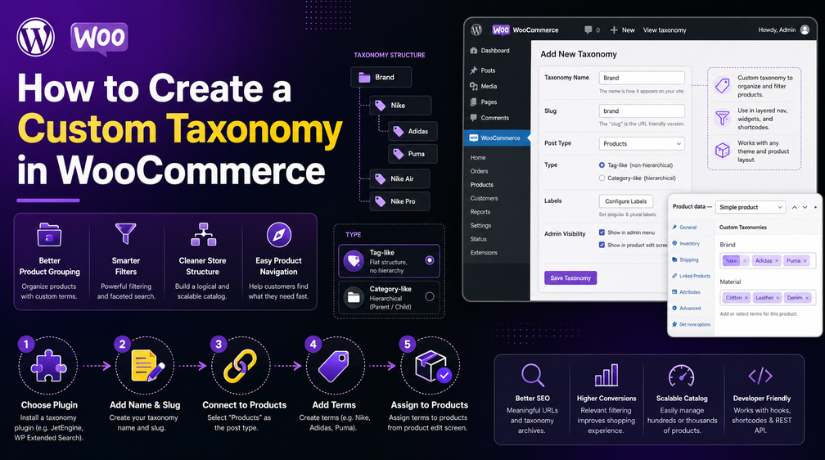
Step 1: Choose the Right Plugin
- First, choose a plugin that can create custom taxonomies.
- It should also support WooCommerce products.
- This is important because products are not normal posts.
- Read the plugin details before installing it.
- Check reviews, updates, and compatibility. A good plugin makes the work much easier.
Step 2: Install and Activate the Plugin
- Go to your WordPress dashboard.
- Open Plugins and click Add New.
- Search for the plugin you want to use.
- Click Install Now. After that, click Activate. The plugin is now ready to use.
Step 3: Open the Plugin Settings
- After activation, open the plugin settings page.
- Some plugins show a new menu in the dashboard.
- Some place settings under Tools or Settings.
- Find the option to create a new taxonomy. This is where the setup starts.
Step 4: Enter the Taxonomy Name
- Now add the name of your taxonomy.
- Keep the name simple and clear.
- Use a name that matches your product grouping.
- Good examples are Brand, Material, Style, or Occasion. This name should be easy to understand later.
Step 5: Add the Taxonomy Slug
- Next, enter the slug for the taxonomy.
- The slug should be short and clean. Use small letters only.
- Do not use spaces or special symbols. For example, for Brand, the slug can be brand.
- Also make sure the slug is not already used elsewhere.
Step 6: Fill the Label Fields
- Many plugins show extra label fields.
- These control how the taxonomy appears in the dashboard.
- Fill them with simple words. This helps you manage the taxonomy easily.
- It also keeps the admin area clear.
Step 7: Connect the Taxonomy to WooCommerce Products
- Now choose where this taxonomy should be used.
- Select Products or product in the plugin settings.
- This step is very important. If you skip it, the taxonomy will not show on products.
- Your taxonomy must be linked to WooCommerce products properly.
Step 8: Choose Category-Like or Tag-Like Type
- Now choose how the taxonomy should work.
- A category-like taxonomy can have parent and child terms.
- A tag-like taxonomy stays flat.
- Choose the one that fits your store best. For example, Brand usually works like tags.
- Product Type may work like categories.
Step 9: Enable Important Options
- Now check the other options in the plugin.
- Enable admin visibility so you can manage it easily.
- Some plugins also give public and archive options.
- Turn these on only if needed. Keep the settings simple in the beginning.
Step 10: Save the Taxonomy
- After filling all fields, click Save.
- The plugin will now create the taxonomy.
- Once saved, check the Products section. Your new taxonomy should now appear there.
- This means the setup is working.
Step 11: Add Terms to the New Taxonomy
- Now add terms under your taxonomy.
- Terms are the actual values you will use.
- For example, under Brand, terms can be Nike, Puma, or Adidas.
- Add the terms carefully. Keep names clean and consistent.
Step 12: Assign Terms to Products
- Now open any WooCommerce product for editing.
- Look for the new taxonomy box on the product page.
- Select the correct term for that product.
- Then click Update to save it. Do this for other products too.
Step 13: Test That Everything Works Properly
- After saving, check whether the terms are saved correctly.
- Open the product again and confirm the selected term is still there.
- Test this on a few products. This helps you make sure the setup works fine.
Step 14: Check the Frontend If Needed
- If your theme or filter plugin supports it, check the frontend too.
- See whether the taxonomy appears in filters or product pages.
- Some taxonomies are only for backend use.
- Others can also help customers while shopping.
Step 15: Refresh Permalinks If You Face Any Issue
- Sometimes the taxonomy does not show properly at first.
- In that case, refresh permalinks once.
- Go to Settings > Permalinks.
- Then click Save Changes. This often fixes small display or link issues.
Step 16: Keep the Structure Simple
- Do not create too many taxonomies at once.
- Use only the ones your store really needs.
- Keep names simple and useful. A clean setup is easier to manage later.
- It also keeps your store organized.
Common Problems When Creating a Custom Taxonomy in WooCommerce
Creating a custom taxonomy with a plugin is usually simple. But small problems can still appear during setup. Some issues happen because of plugin settings. Some happen because of slug mistakes or store conflicts. That is why testing every step is important. A well-planned WooCommerce custom taxonomy setup works much better in the long run.
The Custom Taxonomy Does Not Show on Product Edit Pages
This is one of the most common problems. You create the taxonomy, but it does not appear inside products. In most cases, the taxonomy was not linked to WooCommerce products correctly. Many plugins ask you to select the post type during setup. If Products or product is not selected, the taxonomy will stay hidden. This is why you must check the object type carefully when you create custom taxonomy WooCommerce stores can actually use.
The Terms Do Not Save Properly After Product Update
Sometimes you assign a term to a product, but it disappears after saving. This usually means the taxonomy settings are incomplete. It can also happen because another plugin is causing a conflict. In some cases, user role permissions may also affect saving. First, check the taxonomy settings again. Then test by disabling other plugins one by one. A working WooCommerce product taxonomy should save terms without trouble.
The Taxonomy Slug Conflicts with Existing Content
A slug conflict is another common issue. This happens when the new taxonomy slug matches an existing category, tag, attribute, or page slug. WordPress may then get confused about which item to load. This can break the taxonomy or create strange behavior. That is why slug planning matters a lot. Before you add taxonomy in WooCommerce, always check your current slugs first. A unique slug keeps the setup clean and safe.
The Taxonomy Shows in Admin but Not on the Frontend
Sometimes the taxonomy works in the dashboard only. You can see it on products, but not on the frontend. This often happens because public visibility settings are turned off. Some plugins create taxonomies for admin use only by default. In other cases, your theme may not display the taxonomy automatically. This does not always mean the taxonomy is broken. It may only need better display settings in your custom taxonomy WordPress WooCommerce setup.
Product Filters Do Not Work with the New Taxonomy
Many store owners create taxonomies for filtering. But sometimes the new taxonomy does not appear in product filters. This can happen because the filter plugin does not support custom taxonomies. It can also happen because the taxonomy was not made public. In some cases, the filter tool needs manual setup. So do not assume every filter plugin works automatically. If filtering is your goal, test it carefully before final use.
Wrong Plugin Settings Create Confusing Results
Some plugins offer many settings during taxonomy creation. These settings can look simple at first. But one wrong option can change how the taxonomy works. For example, category-like and tag-like settings affect the structure. Archive settings affect links and visibility. Admin settings affect where the taxonomy appears. If the setup feels wrong later, review every setting slowly. A correct WooCommerce custom taxonomy setup depends on these small details.
Theme or Plugin Conflicts Can Break the Setup
Not every theme or plugin handles custom taxonomies well. Sometimes another tool changes the product edit screen. Sometimes a custom theme hides new taxonomy boxes. Some filter plugins may also conflict with taxonomy settings. This is why testing is very important after setup. If something looks wrong, switch to a default theme for testing. Then disable other plugins one by one. This helps you find the real issue faster.
Permalink Issues Can Affect Taxonomy Pages
Some taxonomy problems are caused by permalink rules. You may create the taxonomy correctly, but links still fail. Archive pages may show 404 errors or broken URLs. This usually happens because WordPress needs to refresh rewrite rules. The fix is simple in most cases. Go to Settings > Permalinks and click Save Changes once. This refresh often solves the issue quickly. It is a good final step after you add taxonomy in WooCommerce.
Too Many Taxonomies Can Make the Store Harder to Manage
A custom taxonomy is helpful when used the right way. But too many taxonomies can create confusion. Store owners sometimes add many taxonomies without real need. This makes the admin area harder to manage. It can also confuse customers on the frontend. So use only the taxonomies that truly help your store. A simple WooCommerce product taxonomy setup is easier to manage and scale later.
Conclusion
A custom taxonomy can make your store structure much better. It helps you group products in a smarter way. It also improves navigation, filtering, and backend product management. That is why many store owners now create custom taxonomy WooCommerce setups for better control. The plugin method makes this process much easier for beginners. You do not need deep coding knowledge to get started. You only need the right plugin, the right structure, and careful testing.
When done properly, a WooCommerce custom taxonomy can support your store for a long time. It keeps product data cleaner and more useful. It also helps your store grow without creating product confusion. If you want expert help with WooCommerce product taxonomy setup, product filters, or store customization, contact WooHelpDesk. Our team can help you organize your WooCommerce store the right way and make sure everything works smoothly.