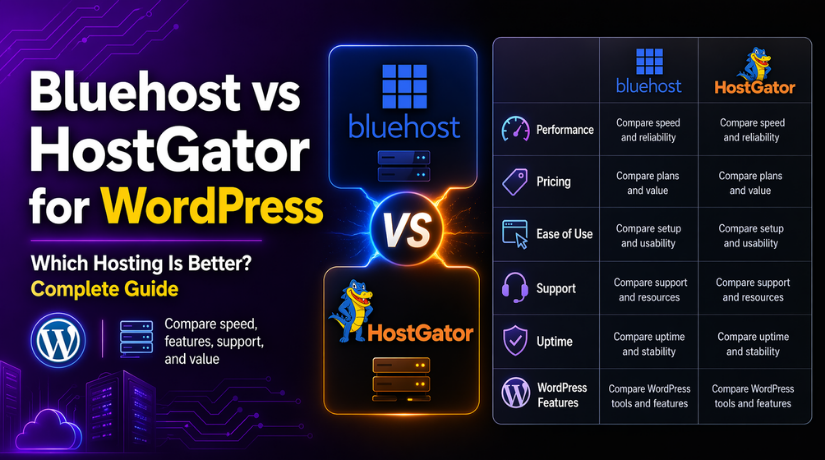
Bluehost vs HostGator for WordPress: Which Hosting Is Better? Complete Guide
Table of Contents
- Introduction
- What is Bluehost?
- What are the Key Features, Pros & Cons of Bluehost?
- What is HostGator?
- What are the Key Features, Pros & Cons of HostGator?
- Is Bluehost or HostGator Good for WordPress Hosting?
- Final Verdict
- FAQs
Introduction
Your choice of web host will be one of the most important decisions you make for your WordPress site. A good host keeps your site fast, secure, and always online. A bad one can cost you traffic, sales, and visitors’ trust.
Two of the biggest names in the industry are Bluehost and HostGator. Both are owned by the same parent company, Newfold Digital, and both host millions of websites. But the similarity ends there. Their reputations, feature sets, and target audiences are surprisingly different.
Bluehost is widely known as the go-to platform for WordPress beginners. It is officially recommended by WordPress.org itself and is famous for its automatic installation tools and beginner‑friendly WonderSuite builder.
HostGator, in contrast, has a reputation as a budget‑friendly, flexible host for general web building. It offers a broad range of services but is often noted for inconsistent customer support.
This guide will break down everything you need to know. You will see how their pricing, performance, security, support, and WordPress‑specific features stack up against each other. By the end, you will know exactly which host is right for you.
What is Bluehost?
Bluehost was founded in 2003 and has grown into one of the most trusted names in web hosting. It currently powers over two million websites worldwide. The company is based in the United States and offers a wide range of services, including shared hosting, VPS hosting, dedicated servers, and managed WordPress hosting.
Bluehost is the longest‑running web host officially recommended by WordPress.org. It has held this endorsement since 2005. This recommendation is not given lightly; it reflects Bluehost’s commitment to WordPress standards, security, and performance.
Core Strengths
- Bluehost is particularly strong for beginners. It offers a free, AI‑powered website builder called WonderSuite that guides you through setup, design, and content creation.
- The platform also provides automatic WordPress installation, a free domain for the first year, and unmetered bandwidth on all plans.
- If you are building an online store, Bluehost’s higher‑tier plans include free daily backups, domain privacy, and malware scanning.
- The company’s VPS and dedicated hosting plans also come with enhanced performance features like NVMe SSD storage and Cloudflare CDN integration.
What are the Key Features, Pros & Cons of Bluehost?
Key Features
- Official WordPress Recommendation: One of the few hosts endorsed by WordPress.org.
- WonderSuite Website Builder: Free, AI‑powered builder for WordPress with WonderStart and WonderBlocks.
- Free Domain & SSL: Free domain for the first year and a free SSL certificate (on most plans).
- Unmetered Bandwidth: No hidden overage fees for traffic spikes.
- SSD Storage: Faster data access compared to traditional hard drives.
- 24/7 Customer Support: Live chat and phone support available around the clock.
- 30‑Day Money‑Back Guarantee: Risk‑free trial period for new customers.
Pros
- Beginner‑Friendly: WonderSuite and automatic WordPress installation make it easy to get started.
- Official WordPress Endorsement: Adds trust and ensures compatibility.
- Affordable Introductory Pricing: Plans start as low as $2.95 per month.
- Good Uptime: Consistently achieves above 99.95% uptime.
- Free Domain and SSL: Reduces initial setup costs.
- Scalable: Options to upgrade to VPS, cloud, or dedicated hosting as your site grows.
Cons
- High Renewal Prices: Introductory rates can double or triple upon renewal.
- Daily Backups Missing on Starter Plan: You need to upgrade for automated daily backups.
- Inconsistent Support Quality: Some users report mixed experiences with support agents.
- No Monthly Plan: Only annual or multi‑year billing is available.
- Upselling: The checkout process includes many add‑on offers.
What is HostGator?
HostGator was founded in 2002, making it slightly older than Bluehost. It is also owned by Newfold Digital and currently hosts over two million domains. The company is best known for its budget‑friendly shared hosting plans and its flexibility in catering to both beginners and experienced developers.
HostGator offers shared, WordPress, VPS, dedicated, and reseller hosting. Its plans often include unmetered bandwidth, a free domain for the first year, and free SSL certificates. The company also provides a 45‑day money‑back guarantee—longer than the industry standard.


WordPress‑Specific Offerings
- HostGator’s managed WordPress plans come in three tiers: Baby, Business, and Pro.
- All plans include pre‑installed WordPress, malware protection, automated backups, and a free domain for the first two years.
- The Baby plan starts at $3.50 per month but renews at $16.49.
What are the Key Features, Pros & Cons of HostGator?
Key Features
- 45‑Day Money‑Back Guarantee: Longer than most competitors.
- Free Domain & SSL: Free domain for the first year and free SSL on all shared plans.
- Unmetered Bandwidth: No caps on data transfer.
- One‑Click WordPress Install: Quick setup for new sites.
- 24/7 Customer Support: Live chat and phone support available.
- DDoS Protection: Included with all plans.
- Scalable Plans: Options to upgrade to VPS, dedicated, or cloud hosting.
Pros
- Generous Money‑Back Guarantee: 45 days gives you plenty of time to test the service.
- Budget‑Friendly Entry Prices: Shared hosting starts as low as $3.75 per month.
- Flexible Hosting Options: Offers everything from shared to dedicated servers.
- Unlimited Storage on Some Plans: Some shared plans advertise unlimited disk space.
- Good Uptime: HostGator maintains a strong uptime record of 99.97%.
Cons
- Inconsistent Customer Support: Many users report slow or ineffective support, especially for technical issues.
- No Free Website Builder: The website builder is a paid add‑on starting at $4.95 per month.
- Higher Renewal Prices: Like Bluehost, renewal rates can be significantly higher.
- No Official WordPress Recommendation: Unlike Bluehost, HostGator is not endorsed by WordPress.org.
- Basic WordPress Optimization: Requires more manual tuning for optimal performance compared to Bluehost.
Is Bluehost or HostGator Good for WordPress Hosting?
- Both companies are capable WordPress hosts, but Bluehost has a clear edge for users who prioritize ease of use, official WordPress support, and a smooth setup process.
- Bluehost is officially recommended by Woorg, a distinction that carries significant weight.
- Its WonderSuite builder and automatic WordPress installation are designed specifically for beginners who want to avoid technical hurdles.
- Bluehost also offers specialized WordPress support teams and built-in caching for better out‑of‑the‑box performance.
- HostGator, while functional, requires more manual configuration to achieve the same level of WordPress optimization.
- It is better suited for developers or experienced users who prefer a more hands‑on approach.
- HostGator’s support for WordPress issues is more general and less specialized.
Final Verdict
When choosing between Bluehost and HostGator, think about your own skill level, budget, and long‑term goals.
Choose Bluehost if you are a beginner, a blogger, or a small business owner who wants a hassle‑free start with WordPress. Bluehost is officially recommended by WordPress.org, and its WonderSuite builder makes site creation almost effortless.
The company offers a free domain, free SSL, and unmetered bandwidth on all plans. While renewal prices are higher, the introductory rates are very affordable. Bluehost is ideal for users who want to focus on content rather than server management.
Choose HostGator if you are on a tight budget and want a longer money‑back window (45 days). HostGator’s shared hosting plans are flexible and can be a good fit for hobby sites or small business websites that don’t require advanced WordPress features.
However, be prepared for higher renewal costs and potentially inconsistent customer support. HostGator is best suited for users who are comfortable with manual configuration and don’t need the official WordPress seal of approval.
In the end, both hosts are owned by the same company and offer similar foundational services. But for most WordPress users—especially those just starting out—Bluehost’s official endorsement, beginner‑friendly tools, and reliable performance make it the better choice. HostGator remains a viable option for budget‑conscious generalists, but it cannot match Bluehost’s seamless WordPress integration.
Have questions before starting with WooCommerce & WordPress? Get support here at WooHelpDesk.