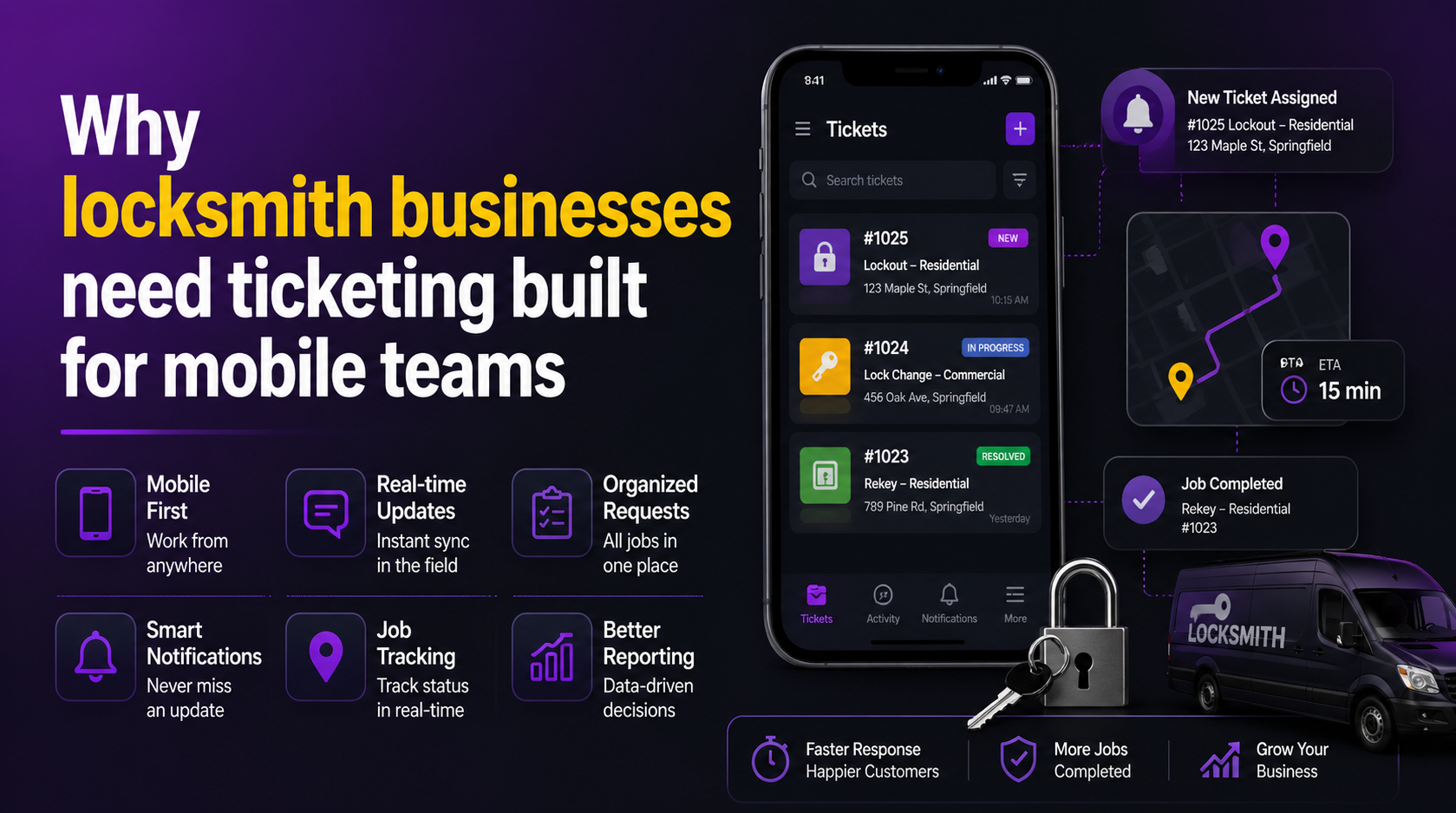
Why locksmith businesses need ticketing built for mobile teams
Locksmith work looks simple from the outside. A customer calls, a technician drives out, the lock gets fixed, and the invoice goes out. In real life, it is messier than that. Calls come in while another job is still open. Emergency lockouts interrupt scheduled work. Commercial clients want updates right away. Residential customers want a clear ETA, not a vague promise. That is why we believe a locksmith business should not treat ticketing like a basic inbox. It needs a workflow that moves with the team, not a static system that only works at a desk.
The pressure is getting higher, not lower. Zendesk’s 2026 customer service research shows that 70% of customers expect anyone they speak with to have the full context of their situation. The same research says 73% of consumers will switch to a competitor after multiple bad experiences, and three in four will spend more with businesses that provide a good customer experience. For a locksmith company, that means every missed note, delayed callback, or confused handoff is not just annoying. It can cost the next job too.
Why generic ticketing stops working in a locksmith business
A standard support system can log a request, but that is only the first five minutes of the job. After that, a locksmith team needs to decide who is available, who is closest, what kind of lock or service issue is involved, whether there is a previous visit on file, and how fast the customer needs help. If those details live in separate calls, text threads, or handwritten notes, the ticket becomes a dead record instead of a live job. That is the real problem. Most generic systems can collect information, but they do not keep the work moving once the day gets busy.
We see the same issue when a business grows from one or two technicians to a real field team. At that stage, the office usually becomes the bottleneck. Staff have to repeat the same details to technicians, retype addresses, chase updates, and ask for job status while the customer is still waiting. A ticketing system built for mobile teams should remove that friction. It should connect intake, dispatch, status changes, and closeout in one process so the office is not acting like a human bridge between disconnected tools.
What the customer side of the problem looks like
The service expectations behind this are worth looking at because they explain why old workflows break so fast.
| Customer service statistic | What it means for locksmith teams |
|---|---|
| 70% of customers expect every representative to have full context | The office and technician need one shared job record |
| 73% of consumers switch after multiple bad experiences | Repeated delays and poor updates can send customers elsewhere |
| 3 in 4 consumers spend more with businesses that provide good CX | Faster, clearer service can improve revenue, not just satisfaction |
| 60% of consumers have bought from a brand based on the service they expected to receive | Response quality influences buying decisions before the job even starts |
Source: Zendesk customer service statistics for 2026.
This is why we do not think locksmith ticketing should be framed as simple case management. The customer is not judging your company by how well you record a complaint. They are judging it by how fast you understand the issue, how clearly you communicate, and whether the technician arrives with the right context. A ticket that does not travel cleanly from the office to the field is not doing enough.
Mobile teams need tickets that turn into jobs
For locksmith businesses, the best ticket is not really a ticket at all. It is the start of the full job lifecycle. It should begin with intake, then flow straight into dispatch, technician instructions, job status, notes, photos, signatures, and billing. When that happens in one system, the office can see what is happening without making extra calls, and technicians can work from one source of truth instead of piecing things together on the road.
That shift is already happening in field service. Geotab’s 2025 State of Field Service Report found that 85% of field service teams already use mobile apps with real time data access and updates. It also found that 76% use AI powered scheduling and dispatch systems, while 52% use automated inventory management. Those numbers tell us something simple. Service companies are no longer treating mobility as a nice extra. They are building around it because the field is where the work happens.
What the field service data says now
Here is the bigger picture behind that shift.
| 2025 field service data point | Share of organizations |
|---|---|
| Use mobile apps with real time data access and updates | 85% |
| Use AI powered scheduling and dispatch systems | 76% |
| Use automated inventory management systems | 52% |
| Plan to adopt AI enhanced customer portals in the next 12 months | 66% |
Source: Geotab, The 2025 State of Field Service Report.


For a locksmith owner, this matters because dispatch is rarely the only weak point. The real drag often comes from small breaks in the chain. The office logs the call correctly but the technician does not get the gate code. The tech finishes the job but the invoice is delayed until the end of the day. A repeat customer calls in, but nobody can see what hardware was used last time. These are not dramatic failures. They are slow leaks. Over time, they cut into margin, customer trust, and technician productivity.
The real cost of running ticketing and field work separately
When ticketing lives in one system and field operations live somewhere else, every handoff gets heavier. The office has to interpret and resend information. Technicians have to ask follow up questions that should already be answered. The customer hears one thing from the office and another thing from the field. That is how simple jobs start feeling chaotic.
This is also where the right software choice starts to matter. A growing locksmith business often reaches the point where it needs more than a shared inbox or general help desk plugin. It needs locksmith software that can connect service requests to dispatch, customer records, status updates, and invoices in one place. We have seen the same pattern in local service brands that already invest in lead generation and reputation building. Even teams that work with trusted Orlando partners such as Smarfle CRM still need tight operational systems once more calls start coming in, because marketing can bring demand, but only clean workflows turn demand into completed jobs.
AI and self service are changing customer service, but not replacing human judgment
A lot of owners hear about AI and imagine something abstract. We think the practical version is much smaller and more useful. AI can help with intake, FAQs, triage, summaries, and simple customer updates. That does not replace the technician or dispatcher. It removes repetitive work so the team can focus on pricing, job complexity, route decisions, and difficult conversations.
Salesforce’s 2025 service research found that service teams using AI agents expect service costs and case resolution times to decrease by an average of 20%. The same research says 30% of service cases were resolved by AI in 2025, and that number is expected to reach 50% by 2027. At the same time, 82% of service professionals said complex cases are best resolved by humans and AI together. That balance feels right for locksmith companies. Customers still want a real person when the problem is urgent or unusual, but they also want faster intake and cleaner updates on the simple parts.
What the AI trend actually means for service operations
| AI and service trend | Current figure |
|---|---|
| Service teams using AI agents expect lower service costs and faster resolution | 20% average decrease expected |
| Service cases resolved by AI in 2025 | 30% |
| Service cases expected to be resolved by AI in 2027 | 50% |
| Service professionals who say complex cases are best resolved by humans and AI together | 82% |
Source: Salesforce State of Service, Seventh Edition and Salesforce customer service research.
That table does not mean locksmith owners should automate everything. It means the market is moving toward faster, more connected service models. The businesses that benefit most will not be the ones that chase every shiny tool. They will be the ones that build one clean workflow from first contact to final payment.
What a locksmith business should look for next
We would keep the buying criteria simple. The right system should let the office create and assign jobs quickly, give technicians live access to job details on mobile, preserve customer history, support status updates without manual follow up, and close jobs with invoicing instead of extra admin work. If one of those steps breaks, the team feels it immediately. If all of them work together, the company starts to feel calmer and faster without adding more people.
That is the real case for mobile first ticketing in locksmith work. It is not about having more software. It is about cutting wasted motion. When the office, the field, and the customer all see the same job clearly, service gets faster, mistakes drop, and the business becomes easier to run. For locksmith companies that want to grow without losing control, that is a much stronger move than squeezing another month out of a generic ticket inbox.