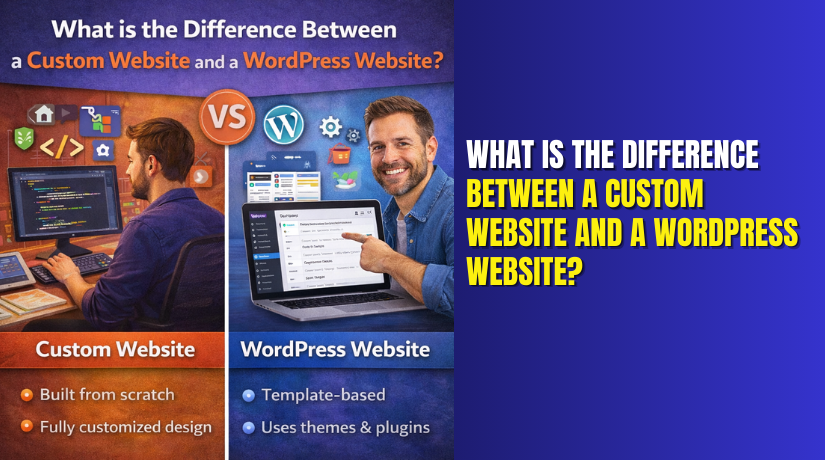
What is the difference between a custom website and a WordPress website?
Table of Contents
- Introduction
- What Is a WordPress Website?
- Understanding Custom Websites
- Benefits of a Custom Website
- Key Differences and Cost Comparison for WordPress vs custom website
- Which Is Best for Small Businesses?
- Pros and Cons Summary for WordPress vs custom website
- Final Thoughts
Introduction
Your website serves as your brand’s initial impression in the modern digital age. It speaks for your company before you do. Whether you run a small company or a global brand, your website shapes how customers see you.
When planning a new website, one question always comes up — should you choose WordPress or a custom website? Both have distinct advantages and are capable of producing excellent outcomes. However, it is often difficult for business owners to distinguish between a custom website and a WordPress website.
Choosing the right option can affect how your website performs, how much it costs, and how easily it can grow. WordPress is known for being user-friendly and cost-effective. On the other hand, a custom-built website gives you total freedom in design and functionality.
In this post, we’ll break down what makes them different, compare their pros and cons, and help you decide which option suits your business goals best in 2026.
What Is a WordPress Website?
WordPress is a content management system (CMS) that allows you to create, edit, and manage your website easily. It powers more than 40% of all websites on the internet — from blogs to online stores.
You don’t need deep coding knowledge to use WordPress. Its themes and plugins make it simple to design and expand your website. For example:
- Themes control how your site looks.
- Plugins add features like contact forms, SEO tools, or payment options.
This flexibility is what makes WordPress so popular. You can start small and scale up later. It’s perfect for startups, small businesses, and professionals who want a reliable and affordable website.
However, WordPress also has a few drawbacks. Too many plugins can slow your site. Regular updates are needed for security. Some customization limits apply unless you know coding.
Still, WordPress customization flexibility is impressive for most users. It offers a great balance between simplicity and power — making it one of the most trusted platforms for modern businesses.
Understanding Custom Websites
Coding languages like HTML, CSS, JavaScript, or frameworks like React and Laravel are used to create a custom website from the ground up. It doesn’t rely on pre-made templates like a WordPress website does. Every feature and design element is created specifically for your business needs.
You have total control over the appearance and functionality of a bespoke website. The structure of a theme or plugin does not restrict you. Everything is built to match your brand, your goals, and your audience.
Benefits of a Custom Website
A custom website offers several strong advantages:
- Unique Design: No two sites look the same. Your website reflects your brand’s identity completely.
- High Performance: Because every line of code is optimized, pages load faster and run smoother.
- Scalability: Your website can change indefinitely as your company expands.
- Strong Security: Custom code is harder for hackers to exploit compared to open-source platforms.
- SEO Flexibility: Developers can fine-tune every technical element for better ranking performance.
However, creating a custom website takes more time and investment than WordPress. You will need skilled developers and ongoing maintenance support. But for businesses that want a long-term digital asset, this investment often delivers lasting value.
In short, when comparing a custom website vs WordPress, the key difference lies in ownership, control, and long-term scalability. A custom-built site is ideal for brands seeking total freedom, speed, and a unique online presence.
Key Differences and Cost Comparison for WordPress vs custom website
Your objectives, financial constraints, and technical requirements will determine whether you choose WordPress or a custom website. Although they function rather differently, both choices can establish a professional online presence. Making an informed decision will be helped by knowing the distinctions between a WordPress website and a bespoke website.
Key Differences Between WordPress and Custom Websites
- Design Flexibility
There are thousands of pre-made WordPress themes and templates available. You can customize colors, fonts, and layouts easily. However, deep changes often need coding or premium plugins.
A custom web design vs WordPress templates comparison shows that custom websites have no design limits. Each component is designed to precisely reflect your concept. - Development Time
WordPress websites can be built quickly using pre-made templates. A small site may be ready in days.
Custom websites, however, take longer because they are coded from scratch. This process includes design, development, and testing before launch. - Cost and Budget
WordPress is more affordable to start. The only things you have to pay for are a domain, hosting, and optional plugins.
Custom websites cost more upfront because they require design and coding work. However, they offer higher performance and longer lifespan. - Maintenance and Updates
WordPress sites need regular updates for plugins and themes. Missing updates can affect security or performance.
Custom websites need developer support for updates, but they don’t rely on third-party plugins as much. - Scalability and Performance
Custom websites perform faster because they use clean, optimized code. They scale better as your business grows.
WordPress can handle growth too, but too many plugins or heavy themes can slow it down. - Ownership and Control
WordPress gives you access to files, but its structure depends on the platform.
With a custom website, you own every part of your code, design, and data — full control and flexibility.
Cost Comparison and ROI
The custom website development cost is higher than building a WordPress site. A small WordPress site might cost between $1,000–$3,000, while a custom website can range from $5,000–$20,000+ depending on complexity.
The return on investment (ROI) may be higher despite the higher original cost. Custom websites are faster, more secure, and easier to scale without future redesigns.
Some people ask, “Is WordPress a custom website?” The answer is no. WordPress is a flexible platform, but it’s not custom-built. However, with skilled developers, it can be customized to act like one.
In conclusion, whether is better—a custom website or WordPress—depends on your objectives. If you want speed and lower cost, WordPress works well. If you want complete freedom and long-term control, a custom website is the stronger investment.
SEO and Performance: Which Wins?
A key consideration when selecting a website platform is search engine optimization, or SEO. Good SEO helps your business appear higher in search results and attract more visitors. However, which is better for SEO: a custom website or WordPress? The answer depends on how each one is built and managed.


WordPress is popular for its SEO-friendly structure. It provides plugins that help users optimize titles, keywords, and meta descriptions, such as Yoast SEO and Rank Math. These tools make SEO simple, even for beginners. It’s simple to add blog entries, update content, and gradually raise your rankings.
However, using too many plugins or using inadequate hosting can negatively impact WordPress performance. Slow sites can reduce SEO scores and increase bounce rates.
A custom website gives developers more control over every SEO element. Both consumers and search engines enjoy a more seamless experience thanks to clean code, optimized pictures, and quicker loading speeds. Developers can also integrate advanced SEO strategies directly into the site’s structure.
In short:
- WordPress is easier for quick SEO setup.
- Custom websites allow deeper, long-term SEO control and faster performance.
Both can perform well, but for large or competitive sites, custom websites often provide stronger results.
Which Is Best for Small Businesses?
For small businesses, choosing between WordPress vs custom website depends on goals and budget.
For small business owners who wish to launch quickly and keep costs down, WordPress is perfect. It offers:
- Affordable setup and hosting
- Ready-to-use templates
- Easy content updates without developers
On the other hand, the benefits of a custom website make it a smart choice for growing businesses. Custom sites deliver unique branding, faster performance, and full flexibility for future upgrades. They also provide stronger integration options, like CRM systems or eCommerce platforms.
If your business is just starting, WordPress gives you everything you need to go online fast. But if you want complete freedom and a future-proof website, a custom-built site is the best long-term choice.
In the end, both options can help your business succeed — it all depends on your vision and goals.
Pros and Cons Summary for WordPress vs custom website
Now that we’ve explored both options, let’s look at the overall pros and cons of WordPress websites and custom websites. Choosing the best option for your company’s needs is made simpler by this comparison.
WordPress Website – Pros:
- Easy to set up and manage without coding.
- Thousands of themes and plugins available.
- Cost-effective for small to medium projects.
- Strong community support and regular updates.
WordPress Website – Cons:
- Performance might be slowed by an excessive number of plugins.
- Need regular security upgrades.
- Limited customization unless you know coding.
Custom Website – Pros:
- 100% unique design that matches your brand.
- High performance with clean, optimized code.
- Strong security and complete data control.
- Fully scalable as your business grows.
Custom Website – Cons:
- Higher upfront development cost.
- Takes more time to design and launch.
- Needs ongoing developer support for updates.
Your company’s size, objectives, and available resources will determine whether you choose WordPress or a custom website.
Final Thoughts
There’s no one-size-fits-all answer in the WordPress vs custom website debate. WordPress is great for small businesses that value simplicity, speed, and affordability. It’s flexible enough to grow with plugins and theme upgrades.
A custom website is ideal for companies that want total design control and advanced features. It offers WordPress customization flexibility and more — performance, uniqueness, and scalability.
If you’re not sure which to pick, begin by determining your company’s objectives, financial constraints, and expansion strategies. For reliable setup, optimization, or maintenance, WooHelpDesk can help you build a powerful website that fits your vision.
The foundation of your digital brand is your website, so make sure it is properly constructed.