How a WooCommerce CRO Agency Improves Ecommerce Performance Through Data-Driven Optimization
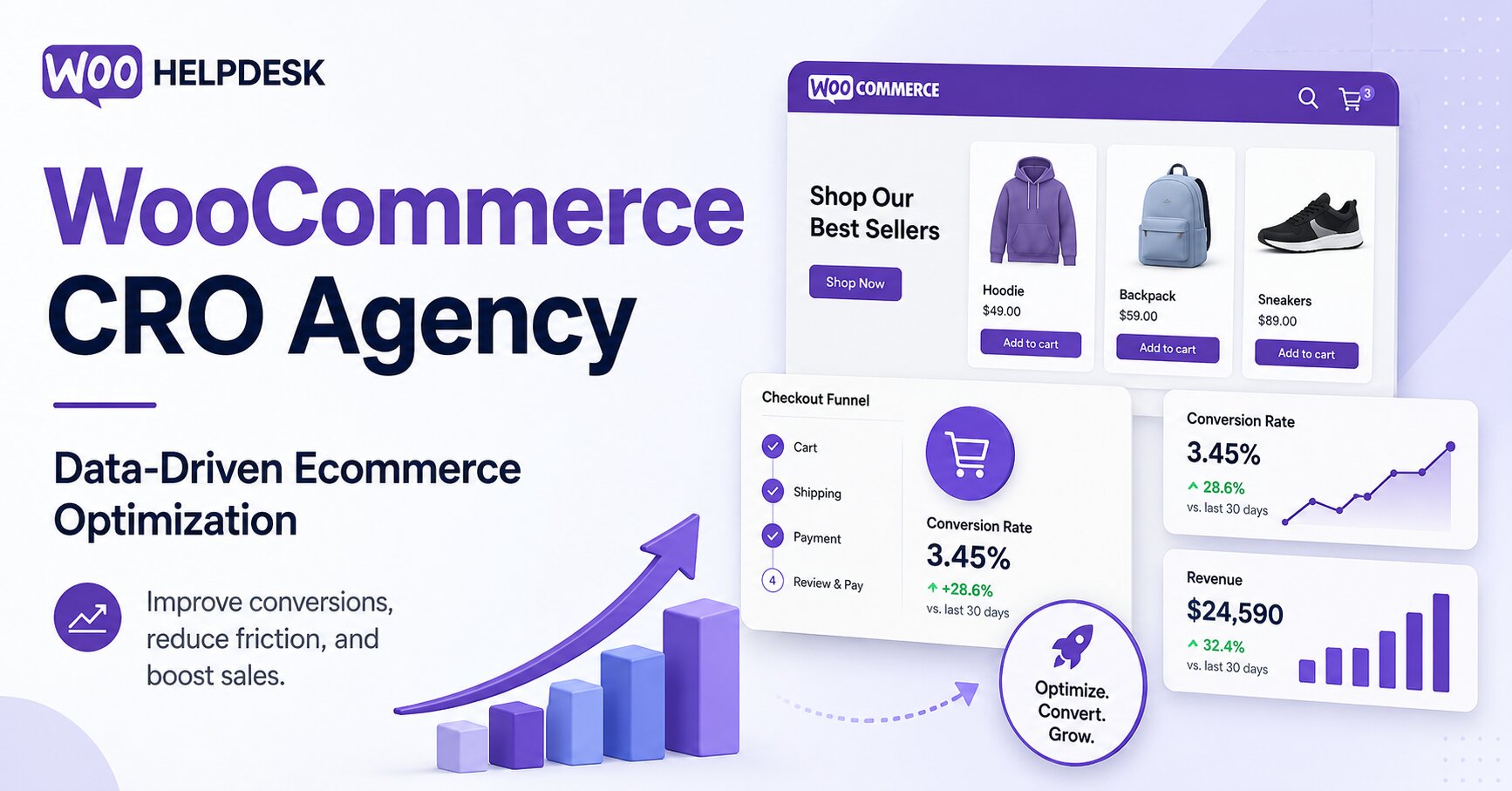
Ecommerce brands often pour money into ads, SEO, and social campaigns to bring in new shoppers. Yet more traffic doesn’t automatically translate into more revenue. A specialized woocommerce cro agency helps merchants get more value from the visitors they already have by studying real shopping behavior and refining every stage of the purchase journey.
Conversion Rate Optimization (CRO) isn’t about guesswork or hunches. It relies on customer research, website analytics, usability improvements, and controlled experimentation. ConversionRate.Store applies this evidence-based methodology to uncover what’s blocking sales and to build changes that measurably improve store performance.
What Is Ecommerce Conversion Rate Optimization?
Ecommerce CRO is the practice of refining an online store so a greater share of visitors take valuable actions, such as:
- Completing a purchase
- Adding a product to the cart
- Subscribing to an email list
- Registering for an account
- Requesting more product details
- Finishing checkout
- Selecting an upsell or bundle
CRO isn’t just about swapping button colors or giving a page a facelift. Real optimization looks at the entire customer path — how shoppers land on the site, browse products, weigh their options, add items to their cart, and pay. It also pinpoints exactly where visitors hesitate, get confused, or lose interest.
The goal isn’t to pressure anyone into buying. It’s to clear away friction so customers can make confident, informed decisions.
Why More Traffic Isn’t Always the Right Fix
When sales slow down, many merchants respond by increasing ad spend. That can bring in more visitors, but it does nothing to fix what’s broken inside the store itself.
Picture a store that gets 100,000 visits a month. If product pages are confusing or checkout is clunky, a large share of that traffic will leave empty-handed. Spending more to attract another 20,000 visitors just adds cost on top of an unsolved problem.
CRO instead focuses on extracting more value from the traffic a store already has, by answering questions like:
- Why are shoppers abandoning product pages?
- What’s driving cart abandonment?
- What information is missing before checkout?
- Are mobile visitors running into technical friction?
- Do customers actually understand the product’s benefits?
- Are shipping costs revealed too late in the process?
- Is there enough trust-building content on the site?
The answers to these questions often reveal growth opportunities that traffic dashboards alone will never surface.
Why WooCommerce Stores Need Dedicated CRO Expertise
WooCommerce gives merchants flexibility and control, but that flexibility comes with a catch: every store runs a different mix of themes, plugins, payment gateways, product types, and customer flows. That variation creates conversion issues that can be hard to spot from the inside.
Common WooCommerce-specific problems include:
- Slow-loading product or checkout pages
- Confusing navigation
- Poorly optimized mobile layouts
- Unclear product variation selectors
- Weak search and filtering tools
- Shipping costs that surprise customers late
- Intrusive pop-ups
- Overly long checkout forms
- Missing trust signals
- Plugin conflicts
- Vague or buried calls to action
- Limited payment options
A general site audit might catch obvious design flaws. A professional CRO engagement goes further — it connects behavioral data, technical performance, customer feedback, and revenue figures to surface issues with a real, measurable impact on the bottom line.
How ConversionRate.Store Turns Data Into Ecommerce Growth
ConversionRate.Store treats CRO as an ongoing cycle of research and experimentation rather than a one-size-fits-all checklist. The team studies each business’s specific audience, product catalog, and sales funnel before recommending anything.
A solid CRO process blends two types of evidence: quantitative and qualitative.
Quantitative Data: What’s Happening
Quantitative data captures measurable site activity, including:
- Traffic sources
- Product page visits
- Cart additions
- Checkout starts
- Completed purchases
- Funnel drop-off points
- Device-level performance
- Customer segments
- Revenue per visitor
- Average order value
This data flags where problems are occurring. For instance, analytics might show a large group of shoppers adding items to their cart but never finishing checkout. That’s a signal — but on its own, it doesn’t explain the “why.”
Qualitative Research: Why It’s Happening
Qualitative research fills in that gap by revealing the reasoning behind customer behavior. Common methods include:
- Customer interviews
- On-site surveys
- Usability testing
- Session recordings
- Heatmaps
- Support ticket feedback
- Review analysis
- On-page polls
These methods often surface issues analytics can’t: shoppers might bail because delivery details are unclear, they can’t tell how a product will fit, they don’t trust an unfamiliar payment method, or mobile users struggle to select product variations.
Putting quantitative and qualitative evidence together builds a much stronger foundation for making changes.
Turning Research Into Testable CRO Hypotheses
Gathering data is only step one. The real work is translating findings into clear, testable hypotheses.
A strong hypothesis ties together four elements:
- Evidence from research or analytics
- A specific customer pain point
- A proposed change to the website
- An expected effect on a business metric
For example, if research shows customers hesitate because return policy details are hard to find, a well-formed hypothesis might read:
“Placing clear return policy information near the Add to Cart button may reduce purchase hesitation and increase add-to-cart rates.”
That’s far more actionable than a vague note like “improve the product page.” It spells out the problem, the fix, the expected shift in behavior, and how success will be measured.
Why Successful CRO Takes More Than One Specialist
CRO draws on research, statistics, design, customer psychology, copywriting, development, and business strategy all at once. A single person might be competent across several of these areas, but true depth in all of them is rare.
ConversionRate.Store builds dedicated project teams around nine core competencies for CRO and User Experience Optimization (UXO) work: a project manager, CRO strategist, UX researcher, data engineer, data analyst, designer, copywriter, developer, and QA specialist. Each role contributes a distinct skill set, and together they carry a project from raw research through to a reliably implemented, tested change.
- Project Management
CRO work involves many moving, interdependent parts — research, analysis, design, development, testing, and reporting all need to happen in sequence. The project manager keeps specialists coordinated and the work aligned with business priorities, including:
- Managing timelines
- Organizing team communication
- Tracking deliverables
- Clearing workflow bottlenecks
- Coordinating stakeholder approvals
- Keeping everyone informed of progress
- Protecting the testing calendar
Without solid coordination, even great research findings can stall and never become live experiments.
- CRO Strategy
The CRO strategist bridges customer research and commercial objectives, deciding which opportunities are worth pursuing and which metrics define success. This role also builds the experimentation roadmap, keeping the team from chasing random ideas.
Instead, every test should tie back to an observed problem and a meaningful business goal, such as:
- Increasing completed purchases
- Improving checkout completion rates
- Raising average order value
- Reducing funnel drop-off
- Increasing revenue per visitor
- Growing qualified leads
- Strengthening customer retention
- UX Research
UX researchers study how real shoppers experience the store — their expectations, motivations, doubts, and frustrations. This might involve investigating:
- What customers expect from product pages
- Which details actually influence a purchase decision
- What causes hesitation at key moments
- Which content is confusing or unclear
- Where navigation breaks down
- Why visitors choose a competitor instead
- What’s stopping customers from trusting the store
Without this research, teams risk optimizing around internal assumptions rather than genuine customer needs.
- Data Engineering
Reliable CRO depends entirely on reliable data. Data engineers make sure website events, ecommerce actions, and key interactions are tracked accurately — things like:
- Product views
- Search queries
- Filter usage
- Variation selections
- Cart additions
- Coupon usage
- Checkout progress
- Payment attempts
- Completed purchases
- Upsell acceptance
Faulty tracking leads to faulty conclusions, so this technical groundwork is essential before any analysis begins.


- Data Analysis
Data analysts convert raw numbers into usable insight, examining user journeys, customer segments, traffic sources, devices, and funnel stages to spot patterns — for example, discovering that mobile shoppers abandon checkout more often, one traffic source converts higher-value orders, returning visitors behave differently than first-timers, a particular payment method causes drop-off, or certain product categories see unusual exit rates. These findings help sharpen where research and testing efforts go next.
- UX and UI Design
Designers translate CRO hypotheses into concrete visual solutions. The goal isn’t a modern look for its own sake — it’s better usability, clearer information hierarchy, and easier decision-making. That can mean:
- Simplifying product page layouts
- Improving mobile navigation
- Making calls to action more prominent
- Clarifying product options
- Trimming unnecessary checkout fields
- Improving product comparison tools
- Surfacing trust signals at the right moments
- Reorganizing product information for clarity
Every design decision should trace back to the evidence behind its hypothesis.
- Conversion Copywriting
Words shape how customers interpret products and weigh risk. A conversion copywriter crafts messaging rooted in real customer concerns and language, aiming for clarity rather than pressure or overblown claims. This often touches:
- Product descriptions
- Headlines
- Calls to action
- Shipping details
- Return policy explanations
- Guarantee messaging
- Checkout instructions
- Error messages
- FAQs
- Upsell and cross-sell copy
- Development
Developers build the approved test variations, and accuracy here matters — technical missteps can distort both the customer experience and the experiment’s results. This work can include:
- Building alternate page versions
- Setting up testing tools
- Updating WooCommerce templates
- Maintaining responsive layouts
- Preserving page speed
- Avoiding plugin conflicts
- Wiring up analytics events
- Supporting more complex experiment setups
- Confirming purchases still work correctly
- Quality Assurance
QA specialists check every experiment before it goes live, testing across common devices, browsers, and screen sizes, including:
- Product selection
- Cart calculations
- Discount codes
- Shipping rules
- Tax calculations
- Payment methods
- Form validation
- Mobile layouts
- Analytics event firing
- Confirmation pages
A single technical slip can erode customer trust or skew test results entirely — QA is the safety net that catches it first.
Why Cross-Functional Teams Make Better CRO Decisions
Each competency answers a different question. The researcher asks why customers struggle. The analyst measures where the problem shows up. The strategist decides whether it’s worth pursuing. The designer builds the fix. The copywriter sharpens the message. The developer ships it. QA confirms it actually works.
A checkout redesign might look like a purely visual task on the surface, but delivering it well can also require analyzing abandonment data, interviewing customers, reviewing technical errors, rewriting confusing instructions, redesigning the form, building the variation, configuring tracking, testing across devices, and measuring the final result. That breadth is exactly why CRO shouldn’t be treated as a stand-alone design task.
The Data-Driven CRO Process, Step by Step
Step 1 — Understand the business. The team reviews the store’s products, audience, traffic sources, business model, and growth targets to build context for everything that follows.
Step 2 — Validate tracking. Analytics and ecommerce event tracking are checked before any conclusions are drawn, since missing or duplicated events can throw off every later decision.
Step 3 — Analyze funnel performance. The team maps how visitors move through landing pages, category pages, search results, product pages, cart, checkout, payment, and confirmation, revealing where the biggest losses happen.
Step 4 — Conduct customer research. Researchers gather direct and indirect feedback to identify objections, unanswered questions, and usability gaps.
Step 5 — Develop and prioritize hypotheses. Evidence becomes test ideas, ranked by potential impact, strength of evidence, effort, and risk.
Step 6 — Design and build the experiment. Designers, copywriters, and developers create the variation aimed squarely at the identified problem.
Step 7 — Run quality assurance. Tracking, functionality, responsiveness, and checkout behavior are verified before launch.
Step 8 — Run the controlled test. The original and new versions are compared, with enough time and data collected before drawing conclusions.
Step 9 — Analyze the results. A finished test should reveal more than a simple win or loss: whether the core metric moved, whether behavior shifted, which segments responded differently, whether the result is statistically reliable, why the variation performed the way it did, and what to carry into the next round of testing.
The Business Case for Working With a CRO Agency
Better use of existing traffic. CRO extracts more value from visitors already coming to the site, easing reliance on ever-increasing ad spend.
Higher revenue per visitor. Improvements to discovery, product pages, checkout, bundles, and upsells raise the value each visit generates.
Less customer friction. Clearer navigation, more useful information, and simpler forms help shoppers move through the store with fewer obstacles.
Stronger mobile experiences. Mobile shoppers deal with smaller screens, slower connections, and fiddlier forms — CRO research often uncovers mobile issues that desktop-only reviews miss entirely.
More confident decision-making. Controlled testing replaces internal debate over “which design is better” with real evidence of how customers actually respond.
Deeper customer understanding. CRO research uncovers customer priorities and concerns that can inform marketing, merchandising, product development, and customer service well beyond the website itself.
Lower risk on major changes. A full site redesign is expensive and uncertain. Testing smaller changes first lets a business validate ideas before rolling them out sitewide.
CRO Is a System, Not a One-Time Redesign
A redesign changes how a store looks and functions at a single point in time. CRO builds an ongoing system for learning and improvement instead.
Customer expectations shift, competitors launch new offers, traffic sources evolve, and new devices and payment methods appear constantly. A store performing well today can develop new friction points tomorrow. Continuous CRO helps merchants keep pace through regular research and testing, following a repeating cycle: Research → Analyze → Prioritize → Design → Test → Learn → Improve.
Even a “failed” test has value — it might disprove a false assumption or reveal that customers care about something the team never expected. The goal was never to make every experiment win; it’s to build a habit of decisions grounded in reliable evidence.
How to Evaluate a WooCommerce CRO Agency
Look past polished portfolios and broad promises. A capable agency should be able to clearly explain:
- How it gathers quantitative and qualitative evidence
- How it validates analytics tracking
- How it identifies conversion barriers
- How it develops hypotheses
- How it prioritizes experiments
- Which specialists are involved in the project
- How tests are built and checked
- How results are measured
- How learnings shape future work
It’s also worth confirming the agency ties its CRO activity to commercial outcomes. Page views and clicks provide useful context, but the program should ultimately be judged against conversion rate, revenue per visitor, average order value, qualified leads, or customer lifetime value.
Final Thoughts
Ecommerce growth isn’t just about attracting more people — it’s about helping the visitors already on the site find products, understand their options, trust the store, and complete their purchase.
Data-driven CRO offers a structured path to that outcome, combining analytics, customer research, UX design, copywriting, development, QA, and ongoing experimentation. ConversionRate.Store’s cross-functional model, built on nine essential CRO and UXO competencies, moves research from raw data to changes that are properly designed, built, tested, and measured.
For WooCommerce merchants, partnering with a specialized CRO agency delivers more than a list of recommendations — it builds a lasting system for understanding customers, removing sales friction, validating decisions, and growing ecommerce performance through evidence rather than guesswork.