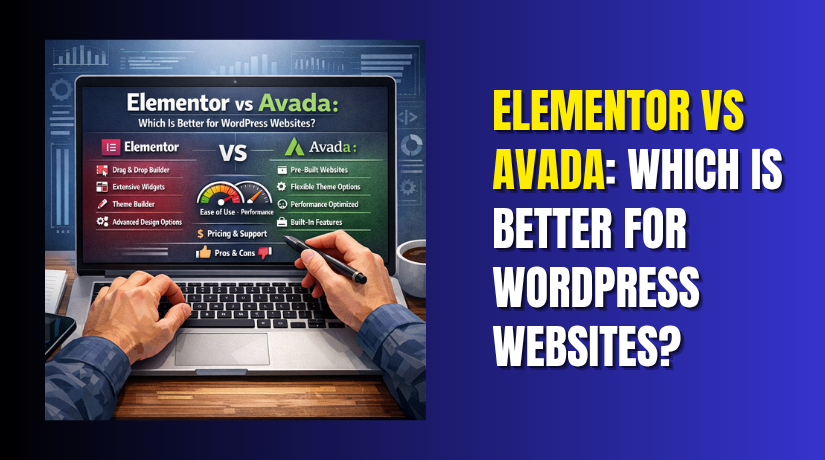
Elementor vs Avada: Which Is Better for WordPress Websites?
Table of Contents
Introduction
You’re staring at two options. One is the best-selling WordPress theme of all time, with over 1 million sales and a near-perfect 4.8-star rating. The other is the most popular page builder plugin, powering more than 5 million websites globally.
Both promise drag-and-drop simplicity. Both claim professional results. Both have passionate fans who swear their choice is superior.
But here’s the crucial distinction most people miss: Avada is a theme, while Elementor is a plugin.
This fundamental difference shapes everything—how you work, what you can customize, how much you’ll pay over time, and whether you can switch tools later without rebuilding your site.
Avada is an all-in-one package that includes the Avada Builder (formerly Fusion Builder), theme options, prebuilt websites, and premium plugins. When you buy Avada, you get everything integrated and ready to use.
Elementor is a plugin that works with any WordPress theme. You can pair it with free themes like Hello Elementor or any premium theme you choose. This gives you flexibility but requires you to assemble your own toolkit.
This comprehensive comparison breaks down everything—features, pricing, flexibility, performance, and real-world usability. By the end, you’ll know exactly which one fits your situation.
What is Elementor?
Elementor is a standalone WordPress plugin that transforms any theme into a fully customizable website. It’s famous for its real-time drag-and-drop editor and high design flexibility.
Elementor is built around the idea that website design should be accessible to everyone, regardless of technical skill. You work directly on the front end—what you see is exactly what your visitors will see.
The plugin doesn’t replace your theme. Instead, it adds a visual design layer on top, letting you create custom layouts while keeping your theme’s structure intact.
In February 2026, Elementor introduced Version 4, a revolutionary update that changes how websites are designed. The new Atomic Editor separates structure, styling, and content—bringing professional design system capabilities to every user.
Key innovations in Version 4 include:
- Atomic Components – Create reusable layout blocks that sync across your entire site. When you edit a component, every instance updates automatically.
- Inline Editing – Click directly on text on the canvas and start editing instantly. No more back-and-forth between the panel and preview.
- Variables Manager – Store and reuse numeric values across spacing, typography, and borders.
- Global CSS Classes – Define styles once and apply them across your site with full cascade support.
- Entrance Interactions – Add performance-friendly motion effects (Fade, Slide, Scale) with granular timing controls.
What are the Key Features, Pros and Cons of Elementor?
Key Features of Elementor
- Front-End Live Editor: Design your pages live with real-time preview. Changes appear instantly as you work.
- 100+ Widgets (40 Free, 60+ Pro): Includes forms, slides, posts, testimonials, call-to-action, and WooCommerce-specific widgets.
- Theme Builder (Pro): Customize headers, footers, single posts, archives, 404 pages, and WooCommerce templates visually.
- Popup Builder (Pro): Create lightboxes, modals, sticky bars, and exit-intent popups without third-party tools.
- WooCommerce Builder (Pro): Full control over product pages, shop archives, cart, and checkout.
- Dynamic Content: Pull data from custom fields, ACF, post meta, and user information.
- Atomic Components (V4): Build once, reuse everywhere. Components stay synchronized across your entire site.
- Global CSS Classes: Style once, apply across your site. Eliminates repetitive work.
- Custom CSS (Pro): Element-level isolated styling with full responsive control.
- 300+ Templates (Pro): Complete website kits, page templates, and block designs.
- Massive Third-Party Ecosystem: Thousands of add-ons (Essential Addons, Crocoblock, JetElements) extend functionality far beyond core.
Pros of Elementor
- Extremely Beginner-Friendly: The drag-and-drop interface is intuitive and forgiving. New users can build pages within minutes.
- Works with Any Theme: Not tied to one ecosystem. Switch themes without losing your page layouts.
- Massive Community: With 5+ million active installs, you’ll find tutorials, Facebook groups, and YouTube content for virtually any question.
- Excellent Third-Party Ecosystem: If Elementor doesn’t have a feature, someone has built an add-on for it. Essential Addons alone adds 100+ widgets.
- Powerful WooCommerce Builder: Full control over product pages, cart, and checkout—something Avada offers but with more design flexibility.
- Built-in Popup Builder: Avada lacks this feature. Elementor Pro users can create complex popups without extra plugins.
- Continuous Innovation: Version 4’s atomic architecture shows Elementor is investing heavily in the future. Features like Components and Global Classes address professional workflow needs.
- Mobile Responsive Controls: Device-specific customization is robust and intuitive.
Cons of Elementor
- Annual Subscription Model: While the free version is generous, Pro requires yearly payment. Over three years for a single site: $177, compared to Avada’s $69 one-time.
- Can Lead to Plugin Bloat: The ecosystem’s strength can become a weakness. Too many third-party add-ons can slow your site and create conflicts.
- Performance Requires Optimization: Out of the box, Elementor isn’t lightweight. It requires good hosting, caching, and careful widget management to achieve top PageSpeed scores.
- Pro Features Locked Behind Paywall: Theme Builder, Popup Builder, and WooCommerce Builder all require Pro. The free version is limited to basic page building.
- Editor Can Feel Heavy on Complex Pages: Deeply nested containers with many widgets can slow the editing experience.
- Learning Curve for Advanced Features: While basic use is simple, mastering Theme Builder, dynamic content, and atomic components takes time.
- No Built-in White-Label for Agencies: Unlike Avada’s Fusion White Label, Elementor’s white-labeling requires third-party solutions.
What is Avada?
Avada is a premium WordPress theme with a built-in visual builder, developed by ThemeFusion and sold on ThemeForest. It’s the best-selling WordPress theme of all time, with over 1 million sales and a near-perfect rating.
Avada takes an all-in-one approach. You buy one product and get everything: the theme, the builder, 110+ prebuilt websites, and premium plugins like Slider Revolution and ACF Pro.
The philosophy is simple: you shouldn’t need to hunt for separate tools. Everything works together out of the box, with deep integration between the theme and builder.


The most recent update, released in March 2026, focuses heavily on WooCommerce enhancements:
- AJAX-Driven WooCommerce Filters – Customers refine products without page reloads, creating an app-like shopping experience.
- Reimagined Woo Sorting Element – Dozens of new styling options for product ordering controls.
- New Woo Filter By Brands Element – Display and filter by product brands with customizable layouts.
- Dynamic Form Notices – Personalize confirmation messages using placeholders like [name] and [email].
Pricing
Avada is a one-time purchase: $69 per site.
- Includes lifetime updates
- 6 months of support (extend to 12 months for ~$21)
- Premium plugins included (Slider Revolution, ACF Pro, Convert Plus)
- Each site needs its own license
What are the Key Features, Pros and Cons of Avada?
Key Features of Avada
- All-in-One Package: Includes theme, Avada Builder, 110+ prebuilt websites, and premium plugins (Slider Revolution, ACF Pro, Convert Plus).
- Avada Builder (Fusion Builder): Front-end live editor plus back-end option. 120+ design elements covering forms, charts, sliders, mega menus, and WooCommerce.
- Performance Wizard: Built-in tool to optimize assets, defer scripts, and improve loading speeds.
- Theme Options Panel: Centralized dashboard for typography, colors, layout spacing, and performance settings.
- Header/Footer Builder: Full visual control over headers, footers, and page title bars—included without needing Pro upgrade.
- Conditional Layouts: Show different templates based on page type, category, user role, or custom conditions.
- Fusion White Label: Rebrand the Avada Builder for client sites—perfect for agencies.
- WooCommerce Integration: Custom product layouts, shop page design, cart and checkout builders. All included in the base price.
- 110+ Prebuilt Website Demos: Full websites with real content and styling. 27 are dedicated WooCommerce shops.
- One-Time Payment: $69 buys lifetime updates. No recurring fees.
Pros of Avada
- Excellent Value for Single Sites: Pay $69 once, use forever. For a single website owner, this beats Elementor’s $177 over three years.
- All-in-One Convenience: No hunting for plugins. Slider Revolution, ACF Pro, and Convert Plus are all included. These alone cost more separately.
- Deep WooCommerce Integration: The 7.15 update adds AJAX filters, brand filtering, and enhanced sorting. E-commerce features are baked into the core.
- Complete Prebuilt Websites: Not just page templates—full sites with real content. Import and tweak rather than build from scratch.
- Fusion White Label: Agencies can rebrand the builder for clients, making it look like their custom solution.
- Performance Wizard: Built-in optimization tools help even non-technical users improve speed.
- One-Time Payment for Agencies? Not exactly—Avada requires per-site licenses, making it expensive for agencies building many sites.
Cons of Avada
- Per-Site Licensing: Each website needs its own $69 license. Building 5 client sites costs $345, while Elementor’s Expert plan covers 25 sites for $199/year.
- Steeper Learning Curve: The interface is dense with options. New users may feel overwhelmed by the theme options panel and builder settings.
- Heavier Out of the Box: Avada loads a lot by default. Without optimization, it can be slow. A speed test without caching showed 72% PageSpeed; with WP Rocket, it improved to 86%.
- Tied to One Theme: You cannot switch themes without rebuilding your design. Avada’s layouts are locked to the Avada ecosystem.
- Built-in Page Builder (Pro and Con): While integrated, the Fusion Builder has fewer third-party extensions than Elementor’s massive ecosystem.
- Smaller Community: With fewer active users than Elementor, finding tutorials and third-party resources can be harder.
- No Popup Builder: Avada lacks a built-in popup tool, requiring third-party plugins for lightboxes, modals, or exit-intent popups.
- No Free Version: You cannot test Avada without purchasing. Elementor’s free version lets you explore before committing.
Which Is Better, Elementor or Avada?
The answer depends entirely on your situation. Here’s a detailed comparison across key categories.
| Comparison Factor | Elementor | Avada | Better |
| What It Is | Plugin (works with any theme) | Theme + Builder (all-in-one) | Depends on need |
| Ease of Use | Very beginner-friendly, live editor | Moderate learning curve, dense options | Elementor |
| Design Flexibility | Extremely high (add-ons, any theme) | High but theme-locked | Elementor |
| Templates/Demos | 300+ Pro templates + kits library | 110+ complete prebuilt websites | Avada (completeness) |
| WooCommerce | WooCommerce Builder (Pro) | Deep integration, AJAX filters, brand filtering | Tie |
| Performance (Out of Box) | Moderate, requires optimization | Heavy, requires performance wizard | Tie (both need work) |
| Optimized Performance | With caching + lightweight theme: 80-95 PageSpeed | With WP Rocket: 86 PageSpeed | Elementor (marginally) |
| Pricing (Single Site, 3 Years) | $59 × 3 = $177 | $69 one-time | Avada |
| Pricing (5 Sites, 3 Years) | $199 × 3 = $597 | $69 × 5 = $345 | Avada |
| Pricing (20 Sites, 3 Years) | $199 × 3 = $597 | $69 × 20 = $1,380 | Elementor |
| Free Version | Yes (40 widgets) | No | Elementor |
| Third-Party Ecosystem | Massive (Essential Addons, Crocoblock, etc.) | Limited | Elementor |
| Community Support | Huge (Facebook groups, YouTube) | Moderate | Elementor |
| Support Quality | 24/7 Pro support | Ticket-based (6 months included) | Elementor |
| White-Label Options | Limited (requires third-party) | Fusion White Label included | Avada |
| Popup Builder | Built-in (Pro) | No | Elementor |
| Header/Footer Builder | Pro (Theme Builder) | Included | Tie |
| Latest Innovations | Atomic Editor (V4), Components, Global Classes | AJAX Woo filters, Brand filtering | Elementor |
| Best For | Agencies, freelancers, multi-site builders | Single site owners, all-in-one lovers | Depends on need |
Final Verdict
Elementor and Avada are both excellent tools, but they serve fundamentally different audiences. Your choice should reflect how you work, how many sites you build, and what you value most.
Choose Elementor if you build many client sites, value design flexibility, and want the most intuitive interface. Elementor works with any theme, giving you freedom to switch without rebuilding layouts. The massive third-party ecosystem (Essential Addons, Crocoblock) lets you add functionality Avada can’t match.
Version 4’s atomic architecture—Components, Global Classes, Inline Editing—positions Elementor as the innovation leader for 2026. The pricing model favors agencies building 20+ sites, where Elementor Pro costs $597 over three years compared to Avada’s $1,380.
Choose Avada if you’re building a single site or a few client sites and want everything in one package with a one-time payment. At $69 with lifetime updates, Avada is excellent value for a single website owner. The 110+ prebuilt websites—including 27 complete WooCommerce shops—let you launch quickly without assembling separate tools.
The new AJAX-driven WooCommerce filters in version 7.15 create an app-like shopping experience that Elementor doesn’t match out of the box. Fusion White Label is invaluable for agencies wanting client-branded builders.
For the ultimate WordPress site, there’s a third option worth considering: Divi. Divi combines Avada’s all-in-one approach with Elementor’s unlimited sites licensing. At $89/year or $249 lifetime for unlimited sites, it bridges the pricing gap. For agencies, Divi’s lifetime license often makes more sense than both Avada’s per-site fees and Elementor’s annual subscriptions.
The “better” choice is the one that fits your business model. If you value flexibility and innovation, choose Elementor. If you want everything integrated with a one-time payment, choose Avada. Either way, invest in good hosting, caching, and optimization—because both tools need it to perform at their best.
Have questions before starting with WooCommerce & WordPress? Get support here at WooHelpDesk.