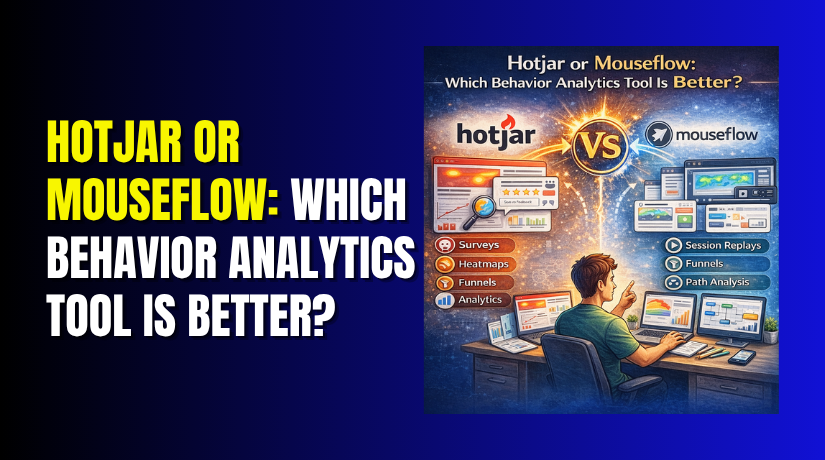
Hotjar or Mouseflow: Which Behavior Analytics Tool Is Better?
Table of Contents
- Introduction
- What is Hotjar?
- How Hotjar Works?
- What are the Key Features, Pros and Cons of Hotjar?
- What is Mouseflow?
- What are the Key Features, Pros and Cons of Mouseflow?
- What is the Difference Between Hotjar and Mouseflow?
- Final Verdict
Introduction
You need to understand how visitors use your website. Where do they click? Where do they hesitate? Why do they leave before buying?
Heatmaps and session recordings promise answers. Two of the most popular tools are Hotjar and Mouseflow. At first glance, they seem similar. Both offer session replays, heatmaps, funnels, and surveys.
But beneath the surface, they are built with different priorities.
Mouseflow is designed for conversion optimization and behavioral depth. Hotjar, now part of Contentsquare, focuses on usability, collaboration, and structured user research.
This distinction matters. The right tool depends on your team’s goals, your technical comfort, and how deeply you need to analyze user behavior.
This guide compares Hotjar and Mouseflow across every important category. You’ll learn their key features, strengths, limitations, pricing differences, and which one fits your specific needs.
What is Hotjar?
Hotjar is a behavior analytics platform that helps teams understand how users interact with their websites through heatmaps, session recordings, surveys, and feedback tools. It was founded in 2014 and has grown to serve over 350,000 customers worldwide.
In 2021, Hotjar was acquired by Contentsquare, a major enterprise digital experience analytics platform. Today, when you purchase Hotjar, you are entering the broader Contentsquare ecosystem rather than buying a standalone product.
This matters for several reasons:
- Hotjar is now positioned within Contentsquare’s enterprise roadmap
- Pricing and feature structures may differ from legacy expectations
- Enterprise buyers may be guided toward broader Contentsquare plans
If you are evaluating Hotjar, you should clarify whether you want the legacy Hotjar functionality or a larger enterprise analytics investment.
How Hotjar Works?
Hotjar installs via a simple JavaScript snippet. Once active, it captures user interactions and presents them through an intuitive dashboard. The platform emphasizes ease of use and quick deployment, making it accessible to non-technical teams.
Key capabilities include:
- Heatmaps – Visualize clicks, scrolls, and mouse movements
- Session recordings – Watch real user journeys through your site
- Conversion funnels – Identify where users drop off
- Surveys and feedback polls – Collect direct user input
- Form analytics – Basic form interaction tracking
What are the Key Features, Pros and Cons of Hotjar?
Key Features
- Heatmaps: Hotjar offers click, scroll, movement, and engagement zone heatmaps. These visual overlays show where users click, how far they scroll, and which areas capture attention. Attention heatmaps, enhanced through Contentsquare integration, highlight where visitors spend the most time.
- Session Recordings: Watch recordings of real user sessions with a clean, intuitive player. The unified multi-tab session view and clickable timeline navigation make it easy to spot usability issues. You can share highlights with teammates via Slack or Teams.
- Funnels: Track conversion paths and identify drop-off points in key user journeys. The trends overview provides aggregated performance data.
- Surveys and Feedback: Collect direct user input through customizable surveys, feedback widgets, and interview recruitment via Engage. The platform includes AI survey generators and AI summary reports.
- Frustration Detection: Hotjar detects rage clicks, u-turns, and frustration scores to help identify usability problems. Console error tracking is available on higher plans.
- Collaboration Tools: Highlights panel, clip sharing, and Slack/Teams integrations make it easy to share insights with teammates.
- Sampling Distribution: Hotjar uses a sampling algorithm to distribute session recordings evenly across the month. This prevents early credit exhaustion and ensures stable coverage.
Pros of Hotjar
- Exceptionally Easy to Use: The interface is clean and intuitive. Non-technical team members can start using it within minutes. Setup requires only a simple JavaScript snippet.
- Strong Collaboration Features: Highlights, clips, and Slack/Teams integrations make sharing insights effortless. Hotjar is built for cross-functional teamwork.
- Built-in User Research Tools: Interview recruitment, feedback widgets, and survey logic are all included. You can gather qualitative insights alongside quantitative data.
- Generous Free Plan: The free plan includes up to 200,000 monthly sessions with unlimited heatmaps and session recordings. This is excellent for testing or smaller sites.
- Visual Clarity: Heatmaps and session recordings are polished and easy to interpret. The interface prioritizes storytelling over raw data.
- 12-Month Data Retention: All plans include 12 months of standard data retention, allowing long-term trend analysis.
Cons of Hotjar


- No Standalone Form Analytics: Hotjar does not offer dedicated field-level form analytics. You can filter recordings by form interaction, but you cannot see exactly where users drop off or which fields cause errors.
- Sampling Approach: Hotjar distributes sessions evenly across the month using an algorithm. You cannot capture all sessions without limits.
- Friction Detection Is Limited: Hotjar detects rage clicks and frustration scores but lacks broader friction signals like click errors, submit failures, and JavaScript errors.
- Fewer Heatmap Types: Only 3 core heatmap types compared to Mouseflow’s 7. No link analytics or advanced click metrics.
- Pricing Complexity After Acquisition: Because Hotjar is now part of Contentsquare, pricing and feature structures may differ from legacy expectations. Enterprise buyers may be guided toward larger, more expensive plans.
- Limitations on Free Plan: Some users note filtering challenges and restrictions on the free tier.
What is Mouseflow?
Mouseflow is a behavior analytics platform focused on conversion optimization and deep user behavior insights. Founded in 2010 in Copenhagen, Denmark, it serves over 165,000 brands worldwide.
How Mouseflow Works?
- Mouseflow tracks clicks, mouse movement, scrolls, forms, and page content as visitors browse your site.
- It sends this data to its platform for analysis.
- The platform emphasizes analytical control, segmentation, and actionable insights.
- The free plan includes 500 monthly sessions with basic features.
- Paid plans start at $25 per month and unlock advanced analytics.
Mouseflow captures all sessions until your monthly limit is reached. There is no daily sampling throttle. This means you get complete behavioral fidelity for every session within your plan.
The platform includes an AI assistant called Mina that turns session recordings into instant insights. Mina understands natural language questions and surfaces user friction and behavior patterns in seconds.
What are the Key Features, Pros and Cons of Mouseflow?
Key Features
- Session Replay with 100+ Filters: Watch detailed session recordings with powerful filtering options. Filter by URL, referrer, device type, browser, location, and custom events. The AI assistant Mina highlights friction points automatically.
- 7 Types of Heatmaps: Mouseflow offers click, scroll, movement, attention, friction, geo, and link heatmaps. Advanced click metrics include hover-to-click rate and time-to-click. Friction heatmaps visualize where users struggle.
- Friction Detection and Error Tracking: Automatically detects 7+ friction signals including rage clicks, click errors, submit failures, speed browsing, 404 errors, and JavaScript errors. Friction score is included on all plans at no extra cost. The friction dashboard helps surface issues affecting your entire website.
- Form Analytics with Field-Level Drop-off: Track exactly where users abandon forms. See time-to-complete, field-specific drop-offs, and replay abandoned form sessions.
- User Journey Analytics: Visualize the complete paths users take through your site. Combine pageviews to see steps between entry and exit.
- Retroactive Funnels: Build conversion funnels that work with historical data. Edit funnels without losing previously captured data.
- Feedback and NPS Surveys: Collect user feedback and NPS scores directly through the platform.
- 100% Session Recording Rate: No sampling. No throttling. Mouseflow captures all sessions within your monthly limit.
- 30+ Integrations: Connect with marketing, analytics, and support tools.
- Built-in Privacy Controls: Strong anonymization, masking, and compliance features. Mouseflow is built in Europe with privacy as a core principle.
Pros of Mouseflow
- Unmatched Behavioral Depth: With 7 heatmap types, 100+ session replay filters, and friction detection, Mouseflow gives analysts the tools they need for deep investigation.
- Form Analytics That Actually Works: Field-level drop-off tracking is a standout feature. If forms drive revenue, Mouseflow is the clear choice.
- No Sampling Blind Spots: Capture every session within your plan limits. No worrying about missed data or uneven distribution.
- AI-Powered Insights: Mina AI turns hours of session watching into minutes. Ask natural language questions and get instant answers.
- Excellent for Conversion Optimization: Every feature—heatmaps, funnels, form analytics, friction detection—is built to help you identify and fix conversion leaks.
- Strong User Ratings: Mouseflow scores 4.6 stars on G2 and 4.7 on Capterra. Users praise its ease of use, actionable insights, and powerful filtering.
- Transparent, Scalable Pricing: Paid plans start at $25 per month with clear tiered options. No hidden costs.
Cons of Mouseflow
- Steeper Learning Curve for Beginners: Advanced filters and analytical depth require some learning. Non-technical users may find Hotjar easier initially.
- Pricing Can Grow with Traffic: As your website traffic increases, higher-tier plans become necessary. For very large sites, costs scale accordingly.
- Shorter Data Retention on Lower Plans: Lower-tier plans include 1-3 months of data retention, compared to Hotjar’s standard 12 months.
- Interface Less Polished Than Hotjar: While functional, the dashboard can feel cluttered when handling multiple projects.
- No Built-in User Research Tools: Mouseflow lacks the interview recruitment and advanced survey logic that Hotjar offers. You may need separate tools for qualitative research.
What is the Difference Between Hotjar and Mouseflow?
| Feature | Hotjar | Mouseflow |
| Sampling Approach | Monthly sampling distribution. Sessions distributed evenly across the month | No daily sampling. Captures all sessions until monthly limit |
| Heatmap Types | 3 core types + engagement zones. Click, scroll, movement | 7 types including click, scroll, movement, attention, friction, geo, link |
| Session Replay Filters | Basic filtering with multi-tab unified view | 100+ filters + Mina AI assistant |
| Friction Detection | Rage clicks, u-turns, frustration score | 7+ signals including click errors, submit failures, 404 errors, JS errors |
| Form Analytics | No standalone form of analytics. Can filter recordings by form interaction | Yes. Field-level drop-off tracking, time-to-complete, replay abandoned forms |
| User Journey Analytics | Funnels with trends overview | Full user journey visualization with page-by-page path analysis |
| Surveys & Feedback | Advanced survey logic, feedback widget, interview recruitment | NPS surveys and basic feedback campaigns |
| Collaboration | Highlights panel, clip sharing, Slack/Teams integrations | Tags, dashboards, and custom views |
| Data Retention | 12 months standard | 1-12 months depending on plan |
| AI Features | AI survey generator, AI summary reports | Mina AI for session replay insights, natural language questions |
| Free Plan | Up to 200,000 sessions/month | 500 sessions/month |
| Paid Plans Start | $49 per month (Growth plan) | $25 per month (Essential plan) |
| User Ratings | 4.3/5 on G2, 4.6/5 on Capterra | 4.6/5 on G2, 4.7/5 on Capterra |
| Privacy Focus | GDPR and CCPA ready | Stronger privacy controls, EU-built, no data selling |
| Best For | Collaboration, user research, visual storytelling | CRO, deep behavioral analysis, form optimization |
Final Verdict
Hotjar or Mouseflow are both excellent behavior analytics tools, but they serve different audiences. Your choice should reflect your team’s goals, technical comfort, and analytical needs.
Choose Mouseflow if conversion optimization and deep behavioral analytics are your priorities. Mouseflow captures all sessions without sampling, gives you 7 heatmap types, and includes dedicated form analytics with field-level drop-off tracking.
The friction detection automatically identifies 7+ signals, and Mina AI turns session recordings into instant insights. If your website relies on forms for lead generation or revenue, or if you need to understand exactly why users abandon checkout, Mouseflow is the stronger choice.
Choose Hotjar if collaboration, user research, and visual storytelling matter most. Hotjar’s interface is polished and intuitive, making it ideal for sharing insights across marketing, product, and design teams. The built-in interview recruitment and advanced survey logic help you gather qualitative feedback alongside behavioral data. The free plan is generous, and the platform is easier for non-technical users to adopt quickly.
Hotjar is now part of Contentsquare, meaning you are entering a larger enterprise ecosystem with potentially different pricing and packaging. Mouseflow remains an independent, focused behavior analytics platform with transparent, scalable pricing.
Have questions before starting with WooCommerce & WordPress? Get support here at WooHelpDesk.