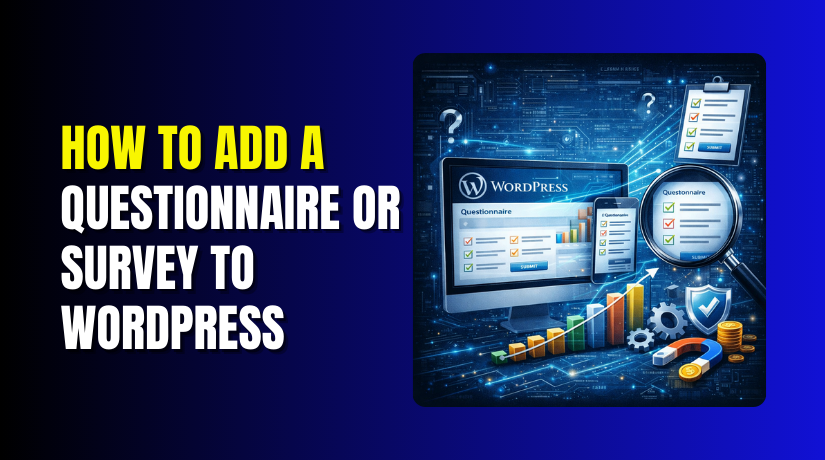
How to Add a Questionnaire or Survey to WordPress: Step-by-Step Guide
Table of Contents
- Introduction
- What is a Questionnaire?
- What are the Key Features of Survey Plugins?
- What are the Benefits of Adding a Survey Form in WordPress?
- How to Add a Questionnaire or Survey to WordPress?
- Final Verdict
Introduction
Understanding your audience is the key to growing your website. Whether you run a blog, an online store, or a business site, knowing what your visitors think helps you make better decisions. Surveys and questionnaires are the most direct way to gather this valuable feedback.
WordPress makes adding surveys surprisingly simple. With the right plugin, you can create professional questionnaires in minutes—no coding required. You can ask customers about their experience, conduct market research, or even create engaging quizzes for your readers.
The benefits are substantial. Businesses that actively collect feedback see higher customer retention rates and make more informed product decisions. Surveys also boost engagement—visitors enjoy sharing their opinions when the process is quick and easy.
This guide walks you through everything you need to know about adding surveys to WordPress. You’ll learn what questionnaires are, their key features, and most importantly, how to create and embed them step by step using the best plugins available in 2026.
By the end, you’ll have a fully functional survey on your WordPress site ready to collect valuable insights.
What is a Questionnaire?
A questionnaire is a research tool consisting of a series of questions designed to gather information from respondents. In the context of WordPress, it’s an interactive form that visitors can complete directly on your website.
Questionnaires serve many purposes. Businesses use them for customer satisfaction surveys. Marketers conduct market research. Educators create quizzes and exams. Event planners handle registrations. Nonprofits collect feedback from supporters.
The key difference between a simple contact form and a questionnaire is structure. Questionnaires typically have multiple questions, often organized into sections or pages. They may include logic that shows different questions based on previous answers.
Types of Questionnaires You Can Create
WordPress supports virtually every type of questionnaire :
| Type | Purpose | Example |
| Customer Satisfaction Surveys | Measure happiness with products or services | “How would you rate your recent purchase?” |
| Market Research | Understand audience demographics and preferences | “What features matter most to you?” |
| Feedback Forms | Collect opinions on specific topics | “What content would you like to see more of?” |
| Quizzes and Assessments | Test knowledge or personality types | “Which product is right for you?” |
| Registration Forms | Sign up users for events or programs | “Workshop registration form” |
| Employee Surveys | Gather internal feedback | “Annual engagement survey” |
| Net Promoter Score (NPS) | Measure customer loyalty | “How likely are you to recommend us?” |
How WordPress Surveys Work?
Most WordPress survey plugins follow a similar pattern:
- Creation: You build your survey using a drag-and-drop interface in your WordPress admin area
- Storage: Questions and settings are saved in your WordPress database
- Embedding: You place a shortcode or block on any page where you want the survey to appear
- Collection: Visitors complete the survey, and responses are saved in your database
- Analysis: You view results through charts, graphs, and exportable reports
Modern plugins offer advanced features like conditional logic, email notifications, and integration with email marketing services.
What are the Key Features of Survey Plugins?
Understanding what features matter helps you choose the right plugin and design effective surveys.
- Multiple Question Types: The best plugins support various question formats. Common types include multiple choice, dropdown, text input, yes/no, rating scales, and image selection. Advanced plugins add matrix questions, Net Promoter Score (NPS), file uploads, and date pickers.
- Conditional Logic (Skip Logic): This powerful feature shows or hides questions based on previous answers. If someone answers “No” to “Did you enjoy our service?” you can skip follow-up questions about specific features. This creates shorter, more relevant surveys.
- Pre-built Templates: Starting from scratch takes time. Quality plugins include templates for common survey types. Customer feedback, event registration, market research, and employee engagement templates give you a head start.
- Analytics and Reporting: Collecting responses is only half the work. Good plugins provide visual reports with charts and graphs . You can see response trends, completion rates, and individual answers. Export options let you analyze data in spreadsheets.
- Spam Protection: Open surveys attract bot submissions. Built-in protection like Google reCAPTCHA or Cloudflare Turnstile blocks automated spam without annoying real users.
- Responsive Design: Over half of web traffic comes from mobile devices. Your surveys must look and work perfectly on phones and tablets. Modern plugins handle this automatically.
- GDPR Compliance: Privacy regulations require clear consent for data collection. Good plugins include GDPR options like consent checkboxes and data anonymization.
- Email Notifications: Know instantly when someone completes your survey. Plugins can send notifications to administrators and confirmation emails to respondents.
- Integrations: Connect your surveys with other tools. Popular integrations include Mailchimp, Google Sheets, Slack, and CRM systems.
What are the Benefits of Adding a Survey Form in WordPress ?
- Direct Audience Insights: Nothing beats hearing directly from your visitors. Surveys reveal what they truly think, not what you assume.
- Improved Decision Making: Data-driven decisions outperform guesses. Survey results guide product development, content strategy, and marketing campaigns.
- Increased Engagement: Visitors enjoy sharing opinions. Interactive surveys keep people on your site longer and encourage return visits.
- Lead Generation: Surveys naturally collect email addresses. With proper setup, each response becomes a potential lead for your business.
- Cost-Effective Research: Professional market research costs thousands. WordPress surveys deliver similar insights for a fraction of the price.
- Quick to Implement: Modern plugins let you create and publish surveys in minutes. You can test ideas and gather feedback immediately.
- Scalable Collection: Digital surveys handle unlimited responses. You can gather feedback from 10 or 10,000 visitors with the same effort.
- Automated Analysis: Charts and reports save hours of manual work. You see results instantly without crunching numbers.
How to Add a Questionnaire or Survey to WordPress?
Adding a survey to WordPress involves choosing a plugin, installing it, creating your survey, and embedding it on your site. Here are step-by-step instructions for the best plugins available in 2026.
Step 1: Choose Your Survey Plugin
Several excellent options exist. Your choice depends on your needs:
| Plugin | Best For | Key Features | Price | Rating |
| SurveyX Builder | All-around free option | Unlimited surveys, 5 question types, 6 themes, reCAPTCHA, analytics dashboard | Free (Pro available) | New |
| Survey Maker | Advanced features | 20+ question types, NPS, conditional logic, email marketing integrations | Free (Pro from $49) | Not yet rated |
| Quill Forms | Conversational surveys | Typeform-style interface, drag-and-drop, 15+ free blocks, payment integrations | Free (Pro available) | 4.7/5 |
| Formidable Forms | Complex data collection | Calculator fields, dynamic fields, view types, Bootstrap integration | Free (Pro from $39.50/year) | 4.6/5 |
| WPForms | User-friendly forms | Drag-and-drop builder, pre-built templates, real-time reports, spam protection | Free (Pro from $199.50/year) | 4.8/5 |
| Quiz and Survey Master | Advanced quizzes | Time limits, question randomization, WPML integration, premium add-ons | Free (Pro from $129/year) | 4.7/5 |
Step 2: Install SurveyX Builder (Recommended Free Option)
SurveyX Builder offers unlimited surveys and responses completely free, making it an excellent starting point.
WordPress Dashboard → Plugins → Add New
- Log in to your WordPress admin dashboard
- In the left menu, hover over “Plugins” and click “Add New”
- In the search box, type “SurveyX Builder”
- Find the plugin in search results
- Click “Install Now”
- After installation, click “Activate”
Step 3: Create Your First Survey with SurveyX Builder
WordPress Dashboard → SurveyX → Add New Survey
Step 3.1: Start a New Survey
- In your WordPress admin menu, click “SurveyX”
- Click “Add New Survey”
- Enter a survey title (e.g., “Customer Satisfaction Survey”)
Step 3.2: Choose a Theme
- SurveyX includes 6 pre-designed themes
- Select one that matches your brand
- Themes handle colors, fonts, and overall appearance
Step 3.3: Add Questions
- Click “Add Question” to create your first question
- Choose a question type:
- Multiple Choice – For single-select options
- Checkbox – For multi-select options
- Text Input – For open-ended responses
- Yes/No – For binary choices
- Dropdown – For compact option lists
- Image Selection – For visual choices
- Enter your question text
- Add answer options (for multiple choice, checkbox, or dropdown)
- Toggle “Required” if you want to force an answer
Step 3.4: Add More Questions
- Click “Add Question” again for each additional question
- Drag and drop questions to reorder them
- Questions appear in this order to respondents
Step 3.5: Configure Settings


- Click the “Settings” tab
- Spam Protection: Enable Google reCAPTCHA v2 to block bots
- Email Notifications: Enter an email address to receive alerts for new responses
- Redirect URL: Optional page to show after survey completion
- Result Message: Custom thank you message
- Access Control: Choose “Anyone” for public surveys or restrict to logged-in users
Step 3.6: Save Your Survey
- Click “Publish” to make your survey live
- Your survey is now saved and ready to embed
Step 4: Embed Your Survey in WordPress
Method A: Using Shortcode
SurveyX provides a shortcode for each survey.
- In your SurveyX surveys list, find the survey ID number
- The shortcode format is [surveyx id=”X”] (replace X with your survey ID)
- Edit the page or post where you want the survey
- Add a “Shortcode” block in the Gutenberg editor
- Paste the shortcode
- Publish or update the page
Method B: Using Gutenberg Block
- Edit the page or post where you want the survey
- Click the “+” icon to add a new block
- Search for “SurveyX”
- Select the SurveyX block
- Choose your survey from the dropdown
- Publish or update the page
Step 5: Install and Use Survey Maker (For Advanced Features)
If you need more advanced question types, Survey Maker offers extensive features .
NWordPress Dashboard → Plugins → Add New
- Search for “Survey Maker”
- Install and activate
- Go to “Survey Maker” → “Add New” to create a survey
Key Features in Survey Maker:
- 20+ question types including rating scales, matrix questions, file upload, and Net Promoter Score
- Multi-page surveys with section breaks
- Conditional logic (Pro) to show questions based on answers
- Results with charts for visual analysis
- Export to CSV for spreadsheet analysis
- Email marketing integrations including Mailchimp and ConvertKit (Pro)
Step 6: Install and Use Quill Forms (For Conversational Surveys)
Quill Forms creates Typeform-style conversational surveys that ask one question at a time, dramatically improving completion rates.
WordPress Dashboard → Plugins → Add New
- Search for “Quill Forms”
- Install and activate
- Go to “Quill Forms” → “Add New” to create your survey
Free Version Includes:
- Welcome Screen Block – Introduction to your survey
- Email Block – Collect email addresses
- Multiple Choice Block – Single or multi-select options
- Dropdown Block – Compact option lists
- Short Text Block – Brief text responses
- Long Text Block – Paragraph answers
- Range Slider Block – Scale responses
- Date Block – Date selection
- Website Block – URL collection
- Statement Block – Information without input
- Thank You Screen – Completion message
- Group Block – Multiple questions on one page
Step 7: Test Your Survey
Before promoting your survey, test thoroughly:
- Open your survey page in an incognito browser window
- Complete the survey as a real user would
- Verify all questions display correctly
- Check that required fields enforce answers
- Submit and confirm you receive a thank you message
- Check your email for notification (if enabled)
- Return to your WordPress dashboard and view responses
Step 8: View and Analyze Responses
For SurveyX Builder:
- Go to “SurveyX” → “Responses”
- View individual submissions
- See summary statistics and charts
- Export data for external analysis
For Survey Maker:
- Go to “Survey Maker” → “Submissions”
- View detailed response data
- See charts and statistics for each question
- Export individual submissions or summaries
- Filter by date range
For Quill Forms:
- Go to “Quill Forms” → “Entries”
- View each submission with all answers
- Export to CSV for analysis
Final Verdict
Adding a questionnaire or survey to WordPress is one of the smartest investments you can make in understanding your audience. The process is straightforward, the tools are powerful, and the insights you gain are invaluable.
For most users starting out, SurveyX Builder offers the best combination of features and value with unlimited surveys and responses completely free. If you need advanced question types like NPS or matrix questions, Survey Maker’s one-time $49 investment is well worth it.
For maximum engagement and higher completion rates, Quill Forms delivers a conversational Typeform-style experience that keeps respondents focused one question at a time.
Your survey strategy should start simple. Create a basic customer feedback form, embed it on your site, and start collecting responses today. As you learn what works, you can add more sophisticated questions and conditional logic.
The data you collect will guide better business decisions, improve customer satisfaction, and ultimately help your site succeed. Choose your plugin, follow the steps in this guide, and launch your first survey now—your audience is waiting to tell you what they think.
Have questions before starting with WooCommerce & WordPress? Get support here at WooHelpDesk.