Easy Guide: How to Set Up Google Search Console Using Tag Manager
Table of Contents
- Introduction
- What Is Google Search Console & Why You Need It
- Understanding Google Tag Manager (GTM)
- Why Use GTM for GSC Verification
- Step-by-Step Guide on How to Set Up Google Search Console Using Tag Manager
- Post-Verification Checks in Google Search Console
- Conclusion
Introduction
Google offers a free tool called Google Search Console (GSC). It assists website owners in understanding how Google Search affects their site. GSC is an essential tool for anyone who manages a blog, store, or company website. It notifies you of issues and displays how Google views your website.
When your site is verified with GSC, you unlock powerful data. You can check how often people use search to find your website. Additionally, you can monitor which terms generate traffic. That’s a big help if you want more visitors from Google.
Although it may seem technical, setting up Google Search Console is not. This article will show you how to set it up quickly and easily. We’re going to employ Google Tag Manager (GTM). GTM streamlines the setup process by removing the need to modify the code of your website.
Many people avoid GSC because they think it’s hard to use. But once you understand the basics, it becomes one of your most valuable tools. If you care about growing your site, you’ll want to get GSC running as soon as possible.
What Is Google Search Console & Why You Need It
Google Search Console functions similarly to a website health checker. It lets you know what’s functioning well and what needs improvement. GSC also shows how your site ranks in Google and helps you fix SEO issues.
With GSC, you may perform the following:
- Find out which keywords drive traffic to your website.
- Check how many times your site shows in search
- Submit your XML sitemap for faster indexing
- Find and fix mobile usability problems
- Monitor page speed and Core Web Vitals
If you run a WooCommerce store, blog, or business site, GSC is a must. It gives you direct data from Google to improve your SEO.
Without GSC, you’re guessing what’s working. With GSC, you make smart, data-driven changes. That’s why a solid google search console setup is key to SEO success.
Understanding Google Tag Manager (GTM)
One tool that makes tracking and managing tags on your website easier is Google Tag Manager (GTM). Tags are little bits of code that are used to gather information. Google Analytics, for instance, tracks visits via tags. You may manage all of these tags with GTM without changing the code of your website.
What Is Google Tag Manager & How It Works
A free tool for managing tags in one location is Google Tag Manager. Tags can be added, changed, and updated without affecting the code of your website. GTM works by placing a small snippet of code on your site. GTM has control over all tags thanks to this snippet.
The GTM interface makes it simple to manage tags after you’ve added the GTM code to your website. Instead of adding individual codes to your site’s pages, you control everything through GTM.
Here’s how it works:
- Add GTM to your site: Insert a small code into your site’s header and body.
- Add tags: From within GTM, you can add tags for things like Google Analytics, Facebook Pixel, and Google Search Console.
- Publish changes: After setting up, publish the changes and they’ll go live on your website.
Why Google Tag Manager Is Useful for Non-Developers
Google Tag Manager is designed to make things easy for people who don’t have coding experience. GTM is ideal if you are a marketer or small business owner. You may manage your tags with it without contacting a developer.
With GTM, you can:
- Add tracking codes easily: Without Editing the code of your website.
- Manage all tags in one place: No need to handle multiple scripts or plugins.
- Test tags before publishing: Before going live, GTM lets you test your tags to make sure they function properly.
Using GTM to set up Google Search Console saves you from editing your site’s code. It’s a much easier and safer method.
Why Use GTM for GSC Verification
An important initial step in SEO is to verify your website in Google Search Console. Adding a verification HTML file or a meta tag to the header of your website is the conventional approach. However, using Google Tag Manager (GTM) for this process is easier and more efficient, especially for those with no coding experience.
Why Verify Google Search Console with Tag Manager
There are numerous benefits to using GTM to validate your website with Google Search Console. First of all, it’s quick and easy. You don’t have to change the code of your website by hand. GTM lets you handle everything from a single interface.
Here’s why it’s a great choice:
- No coding skills required: GTM lets you manage everything without needing to touch HTML or CSS code.
- Quick setup: It only takes a few minutes to add tags using GTM.
- Flexible management: If you need to add or remove tags, you can do it anytime through GTM.
GTM makes the verification process much smoother. It’s also safer, as you won’t need to deal with any backend files. Changes may always be readily undone from the GTM interface in case something goes wrong.
Pre-Requisites Before You Start
Before setting up Google Search Console using Tag Manager, you’ll need to make sure a few things are in place. Here’s a quick checklist to follow:
- Google Account: You need a Google account to access both Google Tag Manager and Google Search Console.
- Google Tag Manager installed on your site: Your website should already have Google Tag Manager (GTM) installed and configured. Otherwise, you will have to install it first.
- Admin access to your site: You need admin access to make changes to your website, especially when adding the GTM code.
- Google Search Console account: If you haven’t already, register for a Google Search Console account.
By making sure these steps are completed, you’ll be ready to move forward with the verification process.
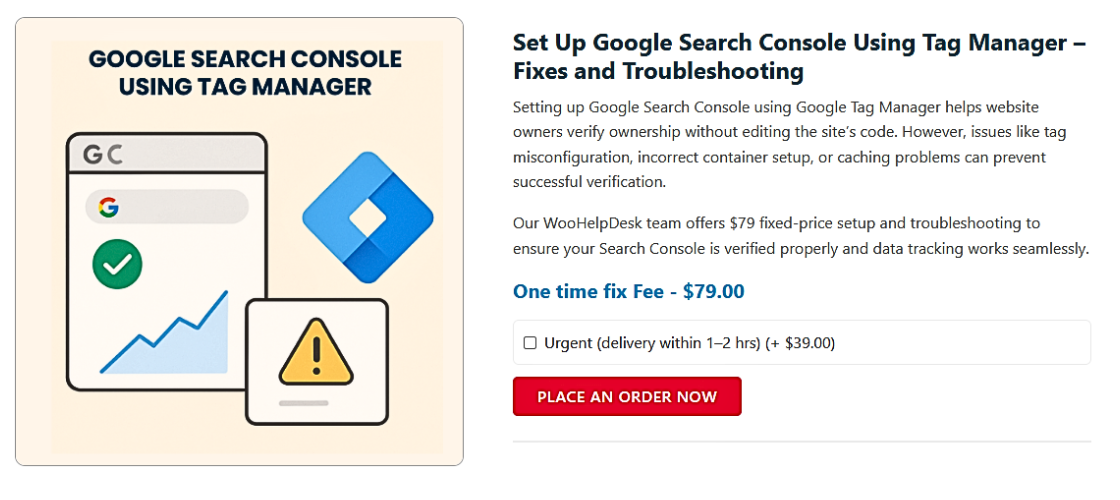
Step-by-Step Guide on How to Set Up Google Search Console Using Tag Manager
In this section, we’ll walk you through how to set up Google Search Console (GSC) using Google Tag Manager (GTM). You may quickly and easily verify your website with GSC without knowing any code by following these instructions.
Step 1: Create a Google Search Console Account
You must first register for a Google Search Console account before you can start. It’s free and easy. Here’s how:
- Go to the Google Search Console website: Visit Google Search Console.
- Sign in with your Google account: Don’t use a different Google account for GTM.
- Add your website property: Click on “Add Property” and choose the URL prefix method (this is the recommended method).
- Enter your website URL: Make sure to enter the full URL, including http:// or https://.
After you’ve added your site, you’ll see a screen asking you to verify ownership. This is where you’ll use GTM for verification.
Step 2: Add Your Website Property to Google Search Console


The next step is to add your website as a property after creating your Google Search Console account.
- Choose URL prefix option: The URL prefix option is the simplest method. It allows you to verify ownership of your website directly.
- Enter your website’s full URL: This should match the URL of your website exactly (including http or https).
- Click “Continue”: Once you’ve entered your website’s URL, click continue.
Google will now request that you validate your website. Instead of using the traditional HTML file or meta tag, you’ll use Google Tag Manager.
Step 3: Select Google Tag Manager as the Verification Method
Here’s where you’ll set up your Google Tag Manager for GSC verification. Follow these steps:
- In Google Search Console, choose GTM as the verification method: After you click on “Continue” to verify your website, Google Search Console will show you different verification methods. Select the Google Tag Manager (GTM) option.
- Copy the GSC verification code: Google will generate a code that you’ll need to add in GTM.
Now, you’re ready to move on to GTM to add this code.
Step 4: Access Google Tag Manager
This is the ideal moment to install Google Tag Manager on your website if you haven’t already. If you have GTM set up, skip to the next step.
- Create a GTM Account: Go to Google Tag Manager and sign in with your Google account.
- Create a new container: Select “Create Container” and name it after your website. The container will hold all your tags (including the GSC verification tag).
- Install the GTM code on your website: GTM will provide a small piece of code. Place this code into the header and body of your website. This step is usually done via your website’s theme settings or via a plugin like Insert Headers and Footers (for WordPress users).
- Publish the container: Return to GTM and publish your container once you’ve added the code to your website.
Step 5: Add the GSC Verification Tag in GTM
Now, let’s add the GSC verification tag to GTM. In this stage, we will utilize the code that was sent by Google Search Console.
- Open your GTM account: Go to the GTM dashboard where you created your container.
- Create a new tag:
- Click on Tags from the left sidebar.
- Click New to create a new tag.
- Choose tag type: Select Custom HTML as the tag type.
- Add the verification code: Paste the verification code from Google Search Console into the HTML field.
- Choose a trigger: Set the trigger to All Pages. This ensures the verification tag will be fired on every page of your site.
- Save the tag: After pasting the code and setting the trigger, save the tag.
Step 6: Test the Tag Before Publishing
It’s always a good idea to test your tags before publishing them. In order to verify that the tag is functioning properly, GTM offers a preview mode.
- Enter Preview Mode in GTM: Click the Preview button in GTM to activate preview mode.
- Visit your website: In preview mode, visit your website. At the bottom of the page, you ought to notice a GTM debugger that indicates which tags are firing.
- Check for the GSC verification tag: Make sure the GSC verification tag is firing correctly on your site.
If the tag shows up as fired, that means it’s working properly.
Step 7: Publish the Tag in GTM
It’s time to publish the tag in GTM after you’ve verified it is functional.
- Go back to GTM: After testing the tag, return to the GTM interface.
- Click on Submit: This will publish the tag live to your website.
- Name your version: Give your version a name and click Publish.
The verification tag is now live on your site, and Google Search Console can verify ownership.
Step 8: Verify Ownership in Google Search Console
Return to Google Search Console once the GTM tag has been published.
- Click on “Verify”: In GSC, click the Verify button.
- Wait for confirmation: Google will check for the tag you added through GTM. You will receive a confirmation that your site has been confirmed if everything is configured properly.
You’ve successfully verified your site with Google Search Console using Tag Manager!
Step 9: Troubleshooting (Optional)
If your verification doesn’t work, here are a few things to check:
- Ensure the GTM code is installed properly: Check if the GTM snippet is added to the correct places in your website’s code.
- Verify the tag firing correctly: Make sure the tag is firing on all pages of your site in GTM’s preview mode.
- Clear your browser cache: Sometimes changes don’t show up right away due to caching.
After verification, you may access your GSC data and begin utilizing the tool to enhance the SEO of your website.
Post-Verification Checks in Google Search Console
After successfully verifying your site with Google Search Console (GSC) using Google Tag Manager (GTM), it’s crucial to confirm that everything is set up properly. This step ensures your website is being tracked and indexed by Google, so you can start optimizing your SEO strategy.
How to Confirm Your GSC Setup Is Working
Once your site is verified in GSC, it’s time to check if the data is flowing in and if Google is properly tracking your website. Here are the steps to confirm that everything is working correctly:
- Log in to Google Search Console:
- Visit Google Search Console.
- Sign in with your Google account to view the dashboard of your website.
- Check the Overview Section:
- On the main GSC dashboard, the Performance graph will show the number of total web search clicks your site has received over time. This graph gives you a quick snapshot of your site’s traffic performance.
- You’ll see data like the number of impressions, clicks, and your site’s average position in search results. This data is updated regularly, and any issues or inconsistencies with indexing will show up here.
- Important: Ensure the data is appearing in the “Performance” section to verify that your site is actively being tracked by Google.
- Review Indexing Status in the “Pages” Report:
- In the Indexing section, click on Pages to see how many of your site’s pages are indexed by Google.
- This report shows you how many of your site’s pages are indexed (marked as green) and how many are not indexed (marked as gray). The graph displays patterns over time, showing if there is a rise or fall in the quantity of indexed pages.
- If there are pages that are not indexed, Google will show you possible reasons why. You can click on the “Reasons” section to identify why a page isn’t indexed.
- Things to check:
- Are the majority of your pages indexed?
- Are there any major spikes or drops in the number of indexed pages?
- Are there any warnings that need your attention, such as noindex tags or robots.txt blocking?
- Check the Performance Report:
- You can get comprehensive stats regarding your site’s Google Search performance under the Performance page.
- Here, you can see key data like:
- Impressions: How frequently pages from your website showed up in Google search results.
- Clicks: The frequency of clicks on your website from search engine results.
- Average position: Your website’s average ranking position for the terms it ranks for.
- You may learn which search terms are bringing visitors to your website with the help of this report. It also identifies areas for performance and visibility improvement.
- Things to look for:
- Are there any queries driving significant clicks and impressions?
- Are your pages ranking higher or lower for certain keywords?
- Do you see any gaps or opportunities to improve SEO?
Next Steps After Setup
Once you’ve confirmed that your GSC setup is working, you can begin using the tool to monitor your site’s performance, improve SEO, and track your progress. The following are some next steps:
- Submit your sitemap: Submitting an XML sitemap, if you haven’t previously, can improve Google’s ability to find and index your content.
- Monitor Core Web Vitals: Use GSC to monitor page speed and other important factors that affect your site’s user experience.
- Track keyword performance: Keep an eye on the Search Results section to identify which keywords are driving traffic to your site.
You can make sure that your website is correctly indexed, validated, and ranking highly in search results by following these procedures.
Conclusion
Setting up Google Search Console using Google Tag Manager simplifies the process of monitoring your site’s performance without needing to touch any code. With the correct configuration, you may learn a lot about the traffic, indexing, and general SEO health of your website. GSC is an excellent first step if you want to improve your website’s exposure and performance in search results. For more tips on optimizing your site and improving user experience, visit WooHelpDesk. Our platform provides easy-to-follow guides and expert advice to help you grow and maintain your website’s SEO strategy with confidence. Allow us to assist you in making the most of your internet visibility!