How to Fix 413 Request Entity Too Large Error in WordPress
Table of Contents
- What Is the 413 Request Entity Too Large Error?
- Why Does the 413 Error Happen in WordPress website
- Understanding the Variations of the 413 Request Entity Too Large Error
- How to Fix 413 Request Entity Too Large Error in WordPress
- Prevent Tips for 413 Request Entity Too Large Error in WordPress
- Conclusion
What Is the 413 Request Entity Too Large Error?
The 413 Request Entity Too Large error is a common issue in WordPress. It happens when you try to upload a file that is bigger than your server allows. The server understands what you’re asking for but refuses to process it because the request is too large.
This error usually appears when uploading big images, themes, or backups. It can also occur during form submissions that carry a lot of data. When this happens, your browser often shows the message “413 Request Entity Too Large.”
This is a type of HTTP error. It belongs to the 4xx family of client-side errors. These errors mean something is wrong with the request sent from the browser to the server. In this case, the problem is with the size of the request.
The error can be broken into three simple parts. The number “413” tells us it’s a client error. The term “Request Entity” refers to the data you’re sending, like files or form entries. And “Too Large” clearly means the server thinks the data is just too big to handle.
Servers have upload limits in place for safety and performance. If your file size goes over that limit, the server blocks the upload. It may even close the connection to stop further attempts.
Sometimes, this error appears under a different name. You might see it as “413 Payload Too Large” instead. Even though the name has changed, most people and browsers still use the older version.
To fix this issue, you have two options. You can compress the file to reduce its size. Or, you can increase your server’s upload limit. Most of the time, the second option is the best and permanent solution.
This error is not about bad code or broken plugins. It’s simply a size mismatch between what you’re sending and what the server allows. Once you change the settings to allow larger uploads, the error should disappear.
Why Does the 413 Error Happen in WordPress website
- Exceeding PHP Upload Limits
WordPress relies on PHP settings to manage file uploads. If upload_max_filesize or post_max_size are set too low, uploading large files will trigger the WordPress upload file too large error. Adjust these values in the php.ini file to accommodate larger uploads.
- NGINX Configuration Restrictions
On NGINX servers, the client_max_body_size directive defines the maximum allowed request size. If this value is too low, uploading sizable files results in a WordPress 413 error Nginx. Modify this directive in the NGINX configuration to resolve the issue.
- Apache Server Limitations
Apache servers use the LimitRequestBody directive to control upload sizes. A low setting here can cause the 413 Request Entity Too Large htaccess error. Update this directive in the .htaccess file to permit larger uploads.
- cPanel Upload Restrictions
In hosting environments using cPanel, default upload limits might be restrictive. Attempting to upload files beyond this limit leads to a 413 Request Entity Too Large cPanel fix scenario. Adjust the upload settings within cPanel to alleviate this problem.
- Memory Limit Constraints
Insufficient PHP memory allocation can hinder large file uploads, leading to a 413 error due to memory limit. Increase the memory_limit value in your server’s PHP configuration to accommodate larger files.
- Large Plugin or Theme Files
Uploading bulky plugins or themes can exceed server limits, causing a plugin upload fails due to 413 error. Compress these files or increase server upload limits to facilitate successful uploads.
- Theme Uploads Exceeding Size Limits
Themes with extensive features may have large file sizes. Uploading such themes can trigger a theme upload blocked due to file size error. Ensure the server’s upload limits are sufficient to prevent this issue.
- Server Configuration Settings
Server configurations may have default settings that restrict large uploads, leading to a request entity too large due to server config error. Review and adjust these settings to enable larger file uploads.
- Apache Timeout Settings
If a file upload takes too long, Apache may time out, resulting in a 413 error due to Apache timeout. Increase the max_execution_time in the server’s configuration to help prevent this timeout.
Understanding the Variations of the 413 Request Entity Too Large Error
The 413 Request Entity Too Large error can manifest under different names across various platforms and server configurations. Recognizing these variations is crucial for effective troubleshooting and resolution.
- 413 Payload Too Large
The term 413 Payload Too Large is a more recent and precise designation for the error previously known as “413 Request Entity Too Large.” This terminology was introduced to provide clearer insight into the nature of the issue, emphasizing that the payload (the data sent in the request) exceeds the server’s capacity. This variation is commonly seen in modern web applications and APIs, aligning with updated HTTP specifications.
- HTTP Error 413
HTTP Error 413 is a general label used to denote the occurrence of this specific client-side error. It indicates that the request sent by the client is larger than what the server is configured to handle. This terminology is often used in logs, error messages, and documentation to succinctly reference the issue without delving into specifics about the payload or entity size.
- 413 Request Entity Too Big
The phrase 413 Request Entity Too Big is an informal variation of the standard error message. While not officially recognized in HTTP specifications, it conveys the same meaning—that the request’s size surpasses the server’s limits. This variation might appear in custom error messages or user interfaces designed to provide more relatable language to end-users.
- Entity Too Large 413
Entity Too Large 413 is another alternative phrasing that emphasizes the size of the entity (the body of the request) being too substantial for the server to process. This variation maintains the numerical error code while reordering the wording, which might be preferred in certain documentation styles or server responses.
- 413 Content Too Large
The term 413 Content Too Large is used to describe situations where the content of the request exceeds server-defined limits. This variation focuses on the content aspect, highlighting that the data being transmitted is too voluminous. It’s particularly relevant in contexts where content size restrictions are strictly enforced, such as file uploads or large form submissions.
- 413 Request Body Too Large
413 Request Body Too Large specifies that the body of the HTTP request is too large for the server to handle. This variation is often encountered in API interactions or web applications where large payloads are transmitted in the request body, such as JSON data or file uploads. It underscores the need to manage request sizes appropriately to prevent such errors.
- 413 Error
The generic term 413 Error is a shorthand reference to the “413 Request Entity Too Large” error. It is commonly used in discussions, logs, and documentation where brevity is preferred. While it lacks specificity, it still conveys the essential information that a client-side error related to request size has occurred.
- Status Code 413
Status Code 413 is the official HTTP status code representing the “Request Entity Too Large” error. This numerical code is used in server responses to indicate that the request size exceeds the server’s capacity. Understanding this status code is vital for developers and system administrators when diagnosing and resolving issues related to large client requests.
- 413 Request Entity Too Large
The original and most widely recognized term, 413 Request Entity Too Large, explicitly states that the request’s entity (body) is too large for the server to process. This terminology is prevalent in server responses, error logs, and documentation, serving as the standard descriptor for this type of client-side error.
- 413 Request Entity Too Large WordPress
In the context of WordPress, the error 413 Request Entity Too Large WordPress often arises when uploading large files, such as themes or plugins, that exceed the server’s configured upload limits. WordPress users encountering this error may need to adjust server settings or use alternative methods to upload large files successfully.
How to Fix 413 Request Entity Too Large Error in WordPress
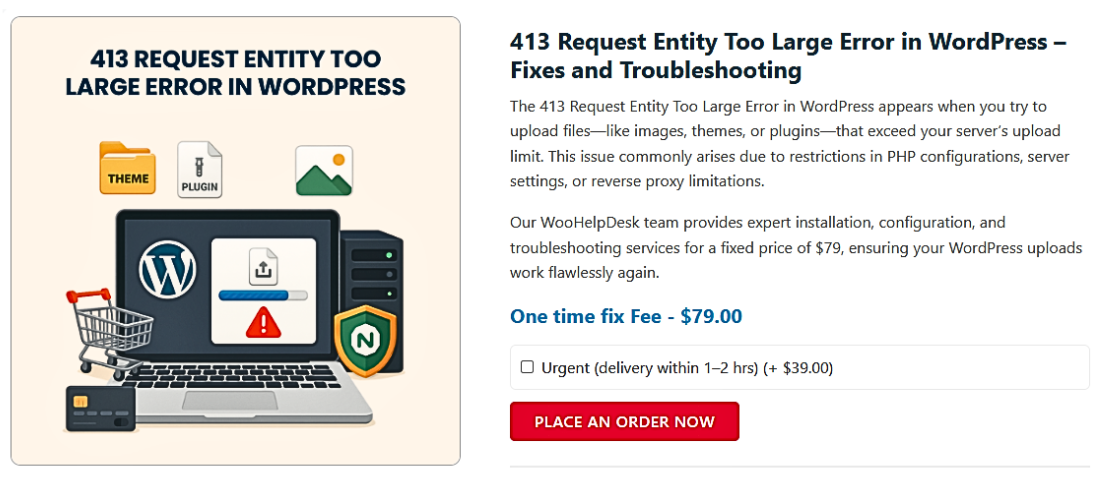
The “413 Request Entity Too Large” error appears when a file exceeds your server’s upload limits. This guide explains how to fix the error step-by-step.
- Reset File Permissions
Incorrect file or folder permissions may cause upload errors. Use your hosting file manager or an FTP client like FileZilla. Locate your WordPress root directory. Right-click to set folder permissions to 755 and files to 644. Apply changes recursively. This ensures proper access rights for uploads.
- Manually Upload the File via FTP
Use FileZilla to connect to your server. Enter your FTP credentials (host, username, password, port). Navigate to wp-content/uploads or wp-content/plugins. Drag your file from the local system into the correct server folder. This bypasses server-side upload limits.
- Increase File Upload Limit from Hosting Panel
Log into your hosting dashboard. Locate the PHP or server settings (e.g., MultiPHP INI Editor). Change values like upload_max_filesize to 256M, post_max_size to 256M, and max_execution_time to 300. Save settings. Create an info.php file with <?php phpinfo(); ?> to verify the updated values in the browser.
- Modify the functions.php File
Access your theme folder via FTP. Navigate to wp-content/themes/your-theme/. Edit the functions.php file. Add the following lines:
@ini_set( ‘upload_max_size’ , ‘256M’ );
@ini_set( ‘post_max_size’, ‘256M’);


@ini_set( ‘max_execution_time’, ‘300’ );
Save the file. Check your browser using info.php to verify changes.
- Modify the .htaccess File
This file is located in your site’s root folder. If it’s hidden, enable show hidden files in FileZilla. Open .htaccess and add:
php_value upload_max_filesize 256M
php_value post_max_size 256M
php_value max_execution_time 300
php_value max_input_time 300
Save changes. Refresh your info.php page to confirm the new limits.
- Modify the nginx.conf File (for NGINX Users)
Use SSH to access your server. Open the nginx config file with:
vi /etc/nginx/nginx.conf
Inside the http or server block, add:
client_max_body_size 256M;
Save and exit. Run nginx -s reload to apply the new configuration.
- Modify Apache Configuration (for Apache Users)
Open .htaccess or httpd.conf file. Add:
LimitRequestBody 268435456
This value sets a limit of 256MB. Save and reload Apache with:
service apache2 reload
This change will allow larger upload sizes.
- Use a WordPress Plugin
Install a plugin like “Increase Max Upload Filesize.” Go to Plugins > Settings. Enter a higher limit like 256MB and save. This is a no-code option suitable for beginners.
- Upload via FTP for Large Plugins or Themes
Use FTP for uploading themes or plugins larger than 256MB. Navigate to:
- wp-content/themes for themes
- wp-content/plugins for plugins
Drag and drop unzipped files into the appropriate folder. Activate them from the WordPress dashboard.
- Contact Your Hosting Provider
If none of these methods work, contact your hosting support. Ask them to increase your upload limits or check CDN settings. They can adjust server configs that are not accessible from your account.
Prevent Tips for 413 Request Entity Too Large Error in WordPress
- Monitor File Upload Sizes Regularly
Keep file sizes small to avoid triggering upload limits. Use optimized images and compressed formats. Before uploading, check the file size against your server limits. This step reduces chances of errors during uploads. Always monitor the upload limit through an info.php file. Keyword: WordPress upload file too large error
- Configure PHP Settings Correctly
Check PHP values like upload_max_filesize, post_max_size, and memory_limit. Set values according to your upload needs. Update these via cPanel, MultiPHP INI Editor, or your php.ini file. Restart server after changes for them to take effect. This helps prevent the 413 error WordPress media upload issue.
- Enable FTP for Large Files
Use FTP when files are too large for browser upload. FTP bypasses server-side upload limits. Drag and drop files into wp-content/uploads or plugins folder. This avoids size-related upload failures. Helps prevent plugin upload fails due to 413 error.
- Regularly Update .htaccess Settings
Keep your .htaccess file optimized with updated limits. Add or review php_value directives related to size and execution time. Keep backup of the file before editing. Helps resolve and prevent 413 Request Entity Too Large htaccess problems.
- Maintain Server Configuration Files
Whether you’re using Apache or NGINX, review your config files. Use appropriate directives like LimitRequestBody or client_max_body_size. Helps avoid errors such as request entity too large due to server config.
- Compress Files Before Uploading
Reduce file size using tools like ZIP or GZIP. Smaller files upload faster and more reliably. Especially useful for media-rich websites. Prevents 413 error due to large file size by staying under size thresholds.
- Break Large Data into Smaller Parts
For forms or bulk imports, split the data into sections. Upload or process the files in stages. This reduces risk of timeout or memory exhaustion. Avoids WordPress error due to max upload size.
- Use WordPress Plugins for Upload Control
Install upload management plugins from the WordPress repository. These plugins allow easy control over file size and execution settings. Helps users increase upload limit WordPress 413 error without technical edits.
- Monitor CDN and Firewall Rules
Content Delivery Networks and Firewalls may block large requests. Review CDN policies and make sure they allow large payloads. Adjust WAF settings to avoid restrictions. Resolves 413 error due to PHP settings on secure sites.
- Contact Hosting Provider When Needed
If none of the fixes work, consult your hosting support. They can review server-side settings, logs, and advanced configurations. Useful when facing 413 Request Entity Too Large WordPress error despite multiple fixes.
Conclusion
The 413 Request Entity Too Large error in WordPress happens when a file you try to upload exceeds the server’s allowed size limit. It’s commonly seen with large themes, images, or backup files. This issue is not caused by bad code but by server restrictions. To fix it, you can increase upload limits through PHP settings, .htaccess, or your hosting control panel. Using FTP for large files also helps. To prevent it, regularly monitor file sizes, compress files, and use plugins to manage limits. If the issue continues, contacting your hosting provider is the best and safest solution.