Difference Between Web Developer and WordPress Developer
Table of Contents
- Introduction
- What Is a Web Developer?
- What Is a WordPress Developer?
- Comparing the Core Skills of Web Developers and WordPress Developers
- Roles and Responsibilities
- Tools and Technologies
- Collaboration and Choosing Between Them
- Common Misconceptions about Web Developers and WordPress Developers
- Conclusion
Introduction
The functions of a WordPress developer and a web developer are frequently confused. Both professionals build websites, but they use different tools and approaches. Understanding their differences is important for business owners and students who want to enter web development. It helps you decide which professional or path suits your goals best.
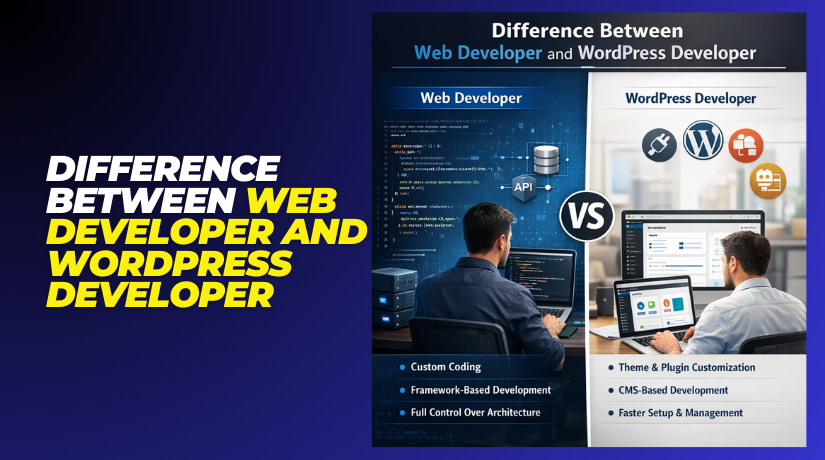
A web developer uses programming languages like HTML, CSS, and JavaScript to create websites from the scratch. They design both how a website looks and how it functions. To handle data and logic, they could also employ back-end languages like Python or PHP. Their work involves full control over how a site is structured, coded, and optimized.
In contrast, a WordPress developer operates within the WordPress content management system (CMS). Instead of coding everything manually, they use pre-built frameworks such as themes and plugins. They customize, design, and extend WordPress websites using tools and PHP-based templates. For the majority of firms, this makes it easier to manage and quicker to develop.
These days, both jobs are crucial. WordPress powers a large share of websites across the internet, from blogs to small business sites. For intricate or highly customized web applications, however, custom web development is still the preferred option. You can select the best option for your website or career path by knowing the differences between a web developer and a WordPress developer.
What Is a Web Developer?
A web developer is a person who uses coding languages and frameworks to create and manage websites. They work on the structure, appearance, and functionality of a site. Three primary categories of web developers exist:
- Front-end developers, who focus on layout, colors, and user experience.
- Back-end developers, who handle data, servers, and application logic.
- Front-end and back-end developers are known as full-stack developers.
Technologies including HTML, CSS, JavaScript, PHP, and SQL databases are frequently used by web developers. Many also use frameworks like Laravel, Vue.js, or React. Their objective is to create scalable, safe, and quick websites that satisfy particular customer needs.
What Is a WordPress Developer?
A WordPress developer is an expert in utilizing WordPress to build and maintain websites. They set up, install, and modify WordPress plugins and themes. Their technical skills include PHP, HTML, CSS, and some JavaScript.
Common tasks include setting up new websites, designing layouts with page builders, developing custom plugins, and improving site performance. WordPress developers work within the WordPress ecosystem, making it easier and quicker to launch websites without heavy coding. Their approach is ideal for blogs, eCommerce stores, and company websites that need easy updates and flexible content management.
In summary, a web developer builds websites entirely through code, while a WordPress developer uses an established platform to build efficient, user-friendly websites faster.
Comparing the Core Skills of Web Developers and WordPress Developers
When comparing a web developer and a WordPress developer, the biggest difference lies in the skills they use. Both professionals create websites, but their tools and workflows are not the same. Understanding their technical and non-technical skills helps explain how each role adds value to a project.
Technical Skills
A web developer builds websites through coding and programming. They use different languages to create structure, style, and interactivity. The most common ones include HTML for layout, CSS for styling, and JavaScript for user actions. Additionally, they process data and run logic behind the website using server-side languages like PHP, Python, or Node.js.
Modern frameworks and libraries are frequently used by web developers to expedite their job. Examples include React, Angular, Vue.js for front-end development, and Laravel or Django for back-end systems. They also take care of hosting and deployment in addition to managing databases like MySQL or MongoDB. They are therefore in charge of a website’s operation as well as its technical performance.
A WordPress developer, in contrast, uses the WordPress CMS as a foundation. Their core technical skills include PHP, HTML, CSS, and some JavaScript. However, they apply these skills differently. Instead of writing every feature from scratch, they customize or create themes and plugins to add new functionality.
WordPress developers also need to understand how WordPress works internally. They use hooks, actions, and filters to modify existing features safely. They may also integrate third-party APIs or tools to extend WordPress capabilities. Technical knowledge of databases, especially MySQL, is important because WordPress stores all content there.
Some common tasks for WordPress developers include:
- Installing and configuring WordPress websites.
- Customizing layouts through child themes.
- Developing or modifying plugins for new features.
- Optimizing performance with caching and image tools.
- Managing site security and regular updates.
While web developers rely heavily on custom code, WordPress developers focus on using and adapting existing WordPress components. Both roles demand problem-solving skills and an understanding of user needs.
Non-Technical Skills
Technical skills are only one part of what makes a good developer. Both web developers and WordPress developers need strong non-technical skills to succeed in real projects.
They are better able to comprehend client wants and accurately explain technical concepts when they have strong communication abilities. Time management and attention to detail ensure that projects stay on track. Both also need basic SEO knowledge, since a well-coded website should perform well in search engines.
A WordPress developer often collaborates with designers, marketers, and content creators. They must understand usability and design principles. A web developer may work closely with system administrators or app developers. They must be able to test, debug, and deploy their code effectively.
In both cases, teamwork and adaptability are key. Technology changes quickly, and both types of developers must keep learning new tools and best practices to stay competitive.
In short, a web developer’s strength lies in deep coding and flexibility, while a WordPress developer’s advantage is speed and efficiency using the WordPress platform. Both skill sets are essential for building modern, reliable, and visually appealing websites.
Roles and Responsibilities
While both web developers and WordPress developers build websites, their daily roles and responsibilities are quite different. Each focuses on specific parts of website creation, depending on the project type and client needs.
A web developer manages a website’s technical and graphic components. Their role begins with planning the website structure and writing the required code. They ensure that the website loads quickly, functions properly on all devices, and runs smoothly. Web developers also manage security, databases, and the integration of advanced features.
A web developer’s typical duties include:
- Creating website layouts with JavaScript, HTML, and CSS.
- Writing server-side logic using PHP, Python, or Node.js.
- Managing and connecting databases.
- Creating APIs for mobile or web applications.
- Testing and debugging code for performance and security.
- Deploying websites and maintaining servers.
They frequently collaborate with content teams and designers to transform mockups into fully functional websites. Since they code from scratch, web developers have more freedom to create complex or unique site features.
A WordPress developer, on the other hand, works within the WordPress ecosystem. Their main focus is on creating, customizing, and maintaining websites that run on the WordPress CMS. While they also use code, much of their work revolves around adapting existing frameworks, themes, and plugins to meet client goals.
Typical duties for a WordPress developer consist of:
- Installing and configuring WordPress on web servers.
- Designing or customizing themes to match branding.
- Creating or modifying plugins for added functionality.
- Controlling updates, caching, and website performance.
- Ensuring the website is safe and responsive on mobile devices.
- Troubleshooting compatibility issues between plugins or themes.
WordPress developers often collaborate with content managers, SEO specialists, and marketing teams. Their efforts guarantee that websites are not only functional but also simple to update without technological expertise.
In this situation, control is the primary distinction between a web developer and a WordPress developer. A web developer builds every element manually, while a WordPress developer uses the WordPress platform to simplify and speed up development.
Tools and Technologies
The tools and technologies each developer uses also differ significantly. A web developer works with many languages and frameworks to build websites from the ground up. Their toolbox includes:


- Text editors and IDEs: Visual Studio Code, Sublime Text.
- Frameworks: React, Vue.js, Angular for front-end; Laravel, Django for back-end.
- Databases: MySQL, PostgreSQL, MongoDB.
- Version control: Git and GitHub for tracking code changes.
- Hosting platforms: AWS, DigitalOcean, or custom servers.
They also use browser debugging tools and performance testing platforms to optimize sites. Because they seek flexibility, web developers can combine different tools according to the needs of the project.
A WordPress developer relies on a different set of tools focused on content management and customization. Their main platform is the WordPress CMS, which they extend with plugins and themes. Common tools include:
- WordPress dashboard: For content, design, and plugin management.
- Page builders: Elementor, Divi, or Gutenberg.
- FTP clients: FileZilla for uploading files to the server.
- Local development tools: LocalWP or XAMPP for testing.
- Performance plugins: WP Rocket, W3 Total Cache.
To increase search exposure, they also employ SEO plugins like Yoast or Rank Math WordPress developers may not use advanced frameworks, but they must understand how themes, plugins, and the WordPress database interact.
In summary, both professionals build and maintain websites but operate differently. Web developers rely on coding and frameworks for flexibility and scalability, while WordPress developers use CMS tools for speed and efficiency. Each role demands a unique mix of creativity, problem-solving, and technical understanding to deliver functional and user-friendly websites.
Collaboration and Choosing Between Them
Collaboration and Work Scenarios
On numerous projects, a web developer and a WordPress developer can collaborate successfully. Their skills often complement each other, especially when a website needs both custom coding and easy content management. Collaboration between these two professionals helps create a strong, secure, and user-friendly website.
In a typical project, the web developer handles the technical foundation. They set up servers, design the database, and build core features using code. Once the base structure is complete, the WordPress developer may take over to integrate these features into a WordPress site. This approach allows the business to benefit from custom features while still managing content easily through the WordPress dashboard.
Here’s a simple example of how collaboration works:
- The web developer builds a custom API or plugin using PHP or JavaScript.
- The WordPress developer connects it to the WordPress site for use by the client.
- Both developers test and adjust the design to ensure smooth performance.
This collaboration guarantees that the finished product is both technically sound and simple to maintain.
In some agencies, web developers build standalone web applications, while WordPress developers handle marketing sites or blogs for the same client. This split allows faster delivery and better efficiency.
When working together, communication is key. Both must understand each other’s workflows, tools, and coding practices. Shared platforms like GitHub, Slack, or project management tools help keep the process smooth.
A common question is, “Can a web developer work with WordPress?” The answer is yes. Many web developers build custom themes, plugins, or integrations for WordPress websites. They often use their coding experience to extend the CMS’s capabilities.
Another common question is, “Is a WordPress developer a web developer?” In many ways, yes. A WordPress developer uses web technologies such as HTML, CSS, PHP, and JavaScript. However, their focus is narrower, centered around the WordPress platform.
When to Choose Which
Choosing between a web developer and a WordPress developer depends on your project’s goals and complexity. Each has qualities that make them appropriate for certain situations.
A WordPress developer should be hired when you:
- Need a website quickly and within a limited budget.
- Want easy updates and content management without coding.
- Plan to run a blog, portfolio, or small eCommerce store.
- Prefer using ready-made plugins and themes.
A web developer is the better choice when you:
- Require a completely unique web application or website.
- Need sophisticated features or integrations that WordPress does not offer.
- Want to build a scalable system with full control over the code.
- Need higher performance or security for enterprise-level solutions.
In many cases, a business benefits from both professionals. A web developer ensures technical quality, while a WordPress developer ensures usability and ongoing management. Together, they help businesses achieve fast, secure, and easily maintainable websites.
Common Misconceptions about Web Developers and WordPress Developers
There are many misconceptions about web developers and WordPress developers. These misunderstandings often cause confusion when businesses look to hire the right person. Clearing them up helps in setting the right expectations.
Many people mistakenly believe that WordPress developers aren’t real developers. WordPress developers use core web technologies like HTML, CSS, PHP, and JavaScript. They also understand databases, server management, and website performance. The real difference lies in the approach, not the skill level. WordPress developers work within an existing CMS, while web developers build everything from scratch.
Another misconception is that web developers cannot use WordPress. In reality, many experienced web developers use WordPress for quick deployment. They build custom themes, plugins, or integrations to extend functionality. WordPress is simply another tool in their toolbox. What matters most is how effectively they use it to meet business goals.
Some people also believe that WordPress is only for small websites. This is far from true. Many large companies, magazines, and eCommerce stores use WordPress. With the right customization and hosting, WordPress can handle large amounts of traffic and complex features.
Here’s a quick breakdown of what’s true:
- Both roles require coding knowledge and technical skills.
- Web developers build custom systems, while WordPress developers extend an existing one.
- WordPress is powerful enough for both small and enterprise-level websites.
- Collaboration between both can produce excellent results.
By understanding these facts, clients and teams can better decide who fits their project needs.
Conclusion
Both web developers and WordPress developers play vital roles in modern website creation. A web developer provides flexibility and control through custom coding. A WordPress developer offers speed and convenience through a user-friendly CMS.
Consider your project’s objectives, budget, and schedule while deciding between the two.
For unique or complex web applications, a web developer is ideal. For content-driven or business websites, a WordPress developer delivers excellent results with less effort and cost.
Both paths require creativity, technical skill, and continuous learning. Whether coding from scratch or customizing WordPress, the goal remains the same — to create a secure, fast, and engaging website for users.
If you need expert help managing, optimizing, or troubleshooting your WordPress website, WooHelpDesk is here for you. Our team specializes in WordPress development, support, and performance optimization to help your site run smoothly and grow online.
Understanding the difference between a web developer and a WordPress developer ensures you make the right choice for your digital success.