Custom Fields vs Attributes in WooCommerce: The Complete Guide
Table of Contents
- Introduction
- What are the Custom Fields in WooCommerce?
- When to Choose Custom Fields?
- What are the Attributes in WooCommerce?
- When to Choose Attributes?
- What is the Difference Between Custom Fields and Attributes in WooCommerce?
- Final Verdict
Introduction
Your WooCommerce store contains product data. Lots of it. But not all data serves the same purpose.
Some information helps customers choose. Size options on a t-shirt. Color swatches for a handbag. Material composition for furniture. This is selection data. Customers make decisions based on it.
Other information simply informs. Weight specifications. Care instructions. Certifications. ISBN numbers. This is reference data. Customers read it but do not act on it.
WooCommerce provides two distinct tools for handling these different needs. Attributes and custom fields. They look similar at first glance. Both let you add extra information to products. But they work completely differently under the surface.
Choose wrong and you miss merchandising opportunities. Choose right and you build a store that sells itself.
Custom fields are key-value pairs that store arbitrary product data. They can hold anything. Text, numbers, dates, file URLs. They appear anywhere you want them to appear. They do not power variations or filters by default .
Attributes are structured product characteristics used for variations and filtering. Size, color, material. They let customers choose options and filter your catalog. They are the engine of product discovery .
This comprehensive guide explains every difference. You will learn exactly what custom fields are and when to use them. You will understand attributes completely. You will see direct comparisons with real examples.
By the end, you will never wonder which tool fits your needs again.
What are the Custom Fields in WooCommerce?
Custom fields, also called custom meta or post meta, are key-value pairs stored alongside a product in the WordPress database . They let you attach arbitrary data to any product without modifying WooCommerce core.
Think of custom fields as sticky notes attached to each product. You decide what the note says. You decide where it appears. You decide whether customers see it at all.
How Custom Fields Work?
Every product in WooCommerce already uses custom fields internally. The regular price is stored as _regular_price. The SKU is stored as _sku. The stock status is stored as _stock_status . WooCommerce itself relies on custom fields for basic functionality.
When you add your own custom fields, you create new meta entries that WooCommerce does not provide out of the box. These entries live in the wp_postmeta table in your database. For stores using High-Performance Order Storage (HPOS) introduced in WooCommerce 8.2, the data may be stored in dedicated tables, but the concept remains identical .
What Custom Fields Can Hold?
Custom fields support virtually any data type:
- Text strings for descriptions, instructions, or notes
- Numbers for weights, dimensions, or ratings
- Dates for release dates or expiration dates
- File URLs for certificates or documentation
- Boolean toggles for yes/no flags
- Serialized arrays for complex data structures
What are the Common Use Cases for Custom Fields?
- Technical specifications: Wattage, dimensions, material composition for electronics or hardware. Customers see detailed specs without cluttering your variation system.
- Regulatory data: Certifications, country of origin, or hazardous-material flags required by law. Store this information safely and display it where required.
- Wholesale pricing tiers: A separate price field visible only to logged-in wholesale users. Custom fields store this data for conditional display.
- Delivery estimates: Per-product lead times that override global shipping estimates. Perfect for items with different production timelines.
- Personalization options: Custom engraving text, gift messages, or upload fields that customers fill out at checkout.
- Real-world examples: A bakery selling cakes can add custom fields for inscription text, delivery date selection, and special dietary requests. A service business can add fields for appointment times and special instructions.
When to Choose Custom Fields?
Choose custom fields when:
- You need to display additional information that customers read but do not select. Specifications, dimensions, certifications, care instructions. This data supports the purchase without being part of the selection process.
- You want to store internal data not shown to customers. Wholesale pricing tiers, supplier codes, cost of goods. Custom fields keep this information organized and accessible.
- You need one-off details for specific products. A limited edition number that applies to only one item. Custom attributes could work, but custom fields offer more flexibility for unique data.
- You want to add customer input fields at checkout. Personalization text, delivery date selection, file uploads. Custom field plugins excel at creating these interactive elements.
- You prefer simple setup without complex configuration. Add a name, add a value, done. No taxonomy management required.
What are the Attributes in WooCommerce?
Attributes are structured product characteristics that define your product options. Size, color, material, fabric, fit. These are attributes .


Unlike custom fields, attributes serve two specific purposes. They enable product variations where each combination has its own price and inventory. They power layered navigation filters so customers can narrow down search results .
Global vs Custom Attributes
- WooCommerce provides two distinct types of attributes. Understanding the difference is essential.
- Global attributes are created centrally under Products → Attributes. You define the attribute name like Color or Size. You add possible values like Red, Blue, Green or Small, Medium, Large. Once created, you can apply these attributes to any product in your catalog.
- Use global attributes when many products share the same options. Clothing stores need size and color across their entire catalog. Creating these globally saves enormous time.
- Custom attributes are created directly inside an individual product’s edit screen. They exist only for that specific product. They are ideal for one-off details that do not repeat across your catalog.
- Use custom attributes for product-specific information. Edition number for a limited run. Special feature unique to one item. Engraving text that applies to only one product.
How Attributes Enable Variations?
The primary purpose of attributes is to power variable products. When you have a product that comes in different versions with different prices, SKUs, or stock levels, you need attributes.
The variation creation process:
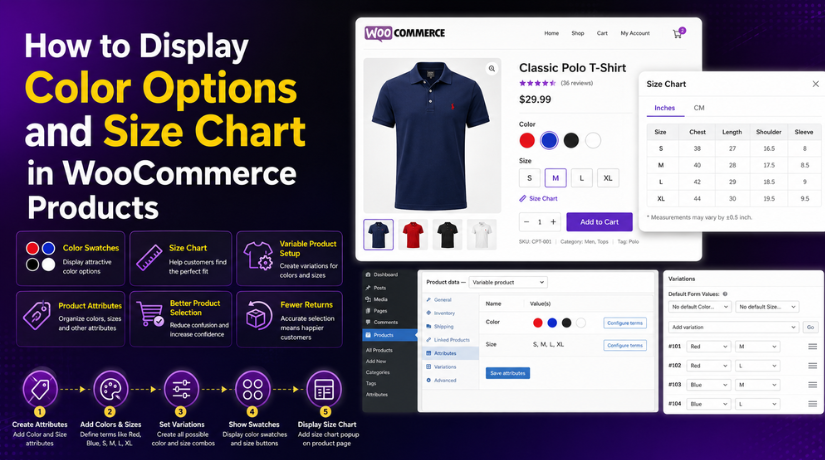
- Create attributes for your options like Size and Color.
- Add terms to each attribute like Small, Medium, Large for Size.
- On your product, select Variable product from the Product Data dropdown.
- Add your attributes to the product and check “Used for variations”.
- Go to the Variations tab and click “Create variations from all attributes”.
- WooCommerce generates every possible combination. Two colors and three sizes create six variations.
- Set prices, SKUs, and stock levels for each variation individually or via bulk edit.
Without attributes, you cannot create variable products. This is their most critical function.
How Attributes Enable Filtering?
- Attributes also power layered navigation. When you add the filter widget to your shop page, customers can narrow products by attribute values.
- A customer looking for blue shirts in medium size clicks those filters. WooCommerce queries your product catalog and shows only matching items. This works because attributes are structured data the system can query efficiently.
When to Choose Attributes?
Choose attributes when:
- You sell products with options that affect price, SKU, or inventory. T-shirts in multiple sizes. Laptops with different configurations. Any product where customers choose one version from many.
- You want customers to filter your catalog by product characteristics. Let shoppers narrow results by color, size, material, or any other meaningful dimension. Attributes make this work instantly.
- You need consistent option sets across many products. Global attributes let you define Color once and use it everywhere. This saves enormous time and ensures consistency.
- You want to display product options elegantly with swatches, images, or labels. Attribute plugins transform boring dropdowns into visual selection tools.
- You care about SEO for option combinations. Each variation can have its own URL, description, and meta data. Attributes make this possible.
What is the Difference Between Custom Fields and Attributes in WooCommerce?
Understanding the distinction between custom fields and attributes is essential for every store owner. While both let you add extra product information, they serve completely different purposes and create vastly different customer experiences.
| Comparison Factor | Custom Fields | Attributes |
| Definition | Key-value pairs storing arbitrary product data. | Structured product characteristics for variations and filtering. |
| Primary Purpose | Display additional information to customers. | Enable product variations and catalog filtering. |
| Customer Interaction | Customers read the information passively. | Customers select options and filter products actively. |
| Variation Support | Cannot create product variations. | Essential for creating variable products. |
| Filtering Capability | Not filterable by default. Requires plugins. | Natively filterable in shop pages. |
| Pricing Impact | Does not affect pricing directly. | Each variation has its own price. |
| SKU Assignment | No SKU association. | Each variation gets its own SKU. |
| Inventory Tracking | No inventory connection. | Each variation tracks its own stock. |
| Global vs Local | Always per-product (local). | Can be global (reusable) or local (per product). |
| Storage Location | wp_postmeta table or HPOS tables. | wp_terms and wp_term_taxonomy tables for global; postmeta for local. |
| Setup Complexity | Simple. Add name and value. | More complex. Requires attribute creation and term definition. |
| Best Use Case | Specifications, certifications, notes, instructions. | Size, color, material, any option customers choose. |
| Examples | ISBN number, warranty period, care instructions, delivery estimate. | T-shirt sizes, shoe colors, laptop configurations. |
| Plugin Requirements | Built-in feature available. Plugins add convenience. | Built-in fully. No plugins required. |
| Display Location | Anywhere you place them via template code. | Automatically on product page and in filters. |
| Database Query | Retrieves single value by key. | Queries taxonomy relationships across products. |
Final Verdict
Custom fields and attributes serve fundamentally different purposes in your WooCommerce store. Neither is inherently better. The right choice depends entirely on what you need the data to do.
Choose custom fields when you need to store and display additional information that customers read but do not select. Technical specifications, regulatory data, internal notes, certifications, and instructional content all belong in custom fields. They are flexible, simple to implement, and perfect for one-off details. Use them for any product data that does not need to power variations or filters .
Choose attributes when customers need to make selections that affect what they buy. Size, color, material, configuration, and any other option that changes price, SKU, or inventory belongs in attributes. They are essential for variable products and catalog filtering. Use them for any product characteristic that customers actively choose .
The technical distinction matters for performance and functionality. Custom fields store simple key-value pairs. They are easy to query individually but do not support complex product relationships. Attributes use taxonomy structures that enable efficient filtering and variation generation across your entire catalog .
Many store owners make the mistake of using custom fields for everything. They add “Size” as a custom field and wonder why they cannot create variations. They add “Color” as a custom field and wonder why customers cannot filter by it. Understanding the difference prevents these errors .
The smartest stores use both tools strategically throughout their catalogs. Custom fields handle the information layer. Specifications, instructions, certifications, internal notes. Attributes handle the selection layer. Sizes, colors, materials, configurations. Together they create complete product pages that inform customers and enable choices.
Test both with your specific products. Monitor which data belongs in which system. Your perfect setup will emerge from understanding these fundamental differences.
Have questions before starting with WooCommerce & WordPress? Get support here at WooHelpDesk.